A 100% occupancy rate suggests underpricing, resulting in missed revenue and excessive wear and tear on the home. Managing Airbnb occupancy requires finding the point where nightly rates and booking volume maximize total profit.
TL;DR
- The U.S. market baseline is approximately 50% occupancy — a 90%+ rate often signals underpricing, not success.
- Calculate Adjusted Occupancy by excluding maintenance blocks from your available night count.
- Airbnb’s Smart Pricing tool prioritizes bookings over rates — it frequently leaves money on the table during local events.
- Focus on RevPAR (Revenue Per Available Room) rather than occupancy alone for a true picture of earning power.
- Diversifying across Vrbo and Booking.com protects against single-platform algorithm changes.
- Replacing large security deposits with damage protection typically removes a booking conversion barrier.
Average Airbnb occupancy rates in the U.S.
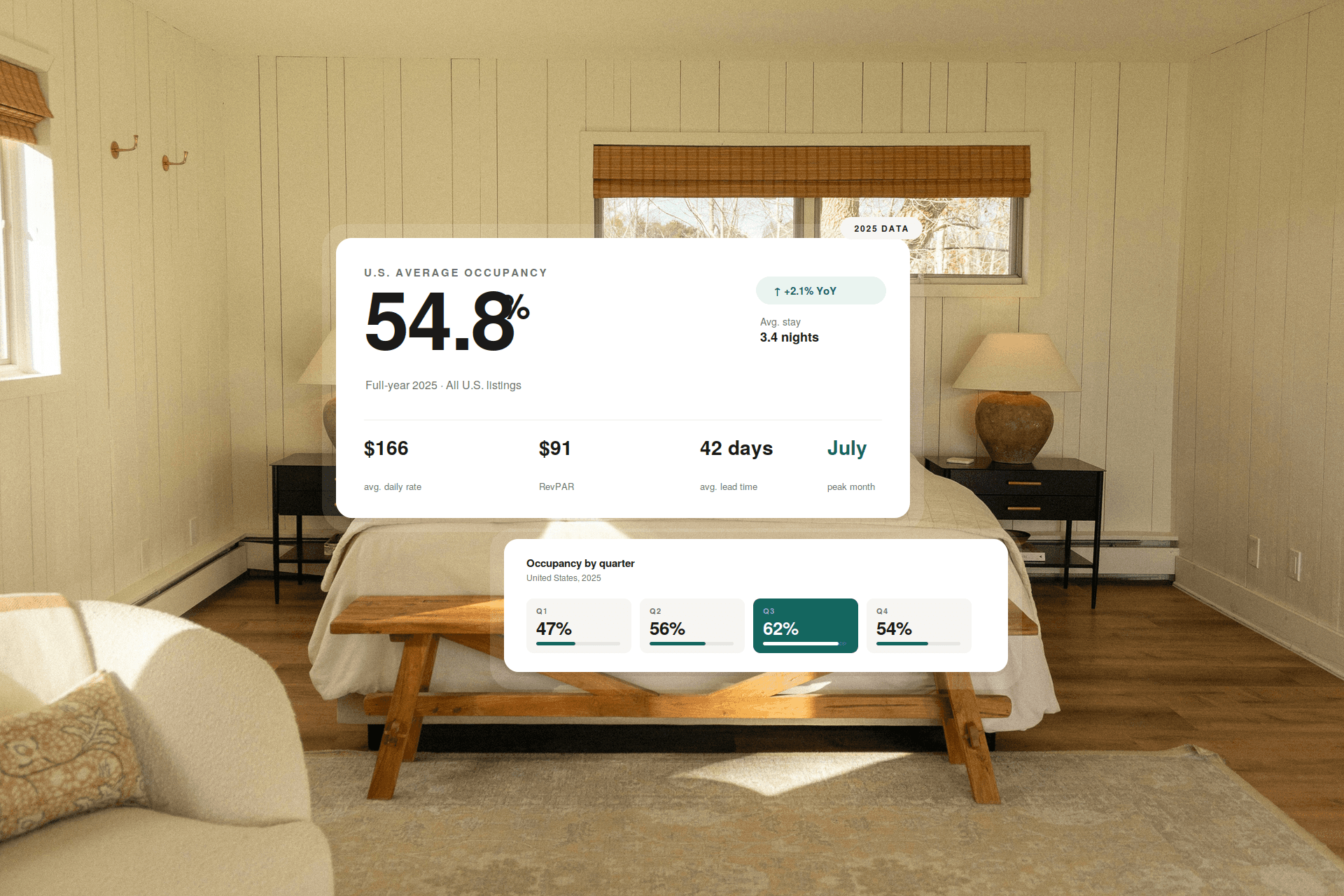
As of mid-2025, the market baseline for Airbnb occupancy in the United States is approximately 50%.
While this may seem low, it represents a stabilizing market after inflated occupancy during the 2021 and 2022 travel boom. Today, a 50–60% occupancy rate is healthy for most year-round markets. Chasing a 90% occupancy rate often leads to margin erosion. This occurs when the costs of cleaning, utilities, and maintenance from high guest turnover exceed the revenue gained from discounted nightly rates.
Calculate your occupancy rate
Move beyond the visual check of your calendar and use the industry standard formula:
Occupancy Rate = (Booked Nights ÷ Available Nights) x 100
Exclude blocked nights for maintenance or personal use from your “Available Nights” count. Professional operators distinguish between Total Occupancy and Adjusted Occupancy. Excluding maintenance days provides a clearer picture of how a listing performs when it is active on the market.
Evaluate factors that influence occupancy
Several variables dictate your baseline potential before you set a price.
Monitor seasonality and market location
A cabin in the Smoky Mountains might reach 85% occupancy in October but drop to 30% in February. An urban apartment in Chicago usually sees steady, mid-range occupancy year-round. Understanding market peaks and troughs allows for realistic goal setting.
Account for property type and size
Smaller units like studios and one-bedrooms often maintain higher occupancy because of the larger pool of solo travelers. Larger four-bedroom homes typically have lower occupancy but command higher nightly rates by catering to groups and families.
Maintain guest reviews and Superhost status
The Airbnb algorithm prioritizes reliability. Listings with a 4.9-star average and a Superhost badge consistently outperform similar listings with lower-quality reviews.
Track lead time and booking windows
Avoid panic-discounting when a calendar looks empty three weeks out. Every market has a specific booking window. Beach destinations often see bookings four months in advance. In urban centers, 40% of bookings may occur within seven days of arrival.
Avoid the smart pricing trap
Many small hosts rely on Airbnb’s native Smart Pricing tool to stay competitive. Veteran operators often refer to this as a “race to the bottom.”
Airbnb’s internal algorithm prioritizes securing a booking over maximizing the rate. This often results in pricing below what the market can bear, particularly during local events or holidays that the native tool might overlook. Professional hosts focus on RevPAR (Revenue Per Available Room). This metric combines occupancy and average daily rates to measure true earning power.
Boost your short term rentals today
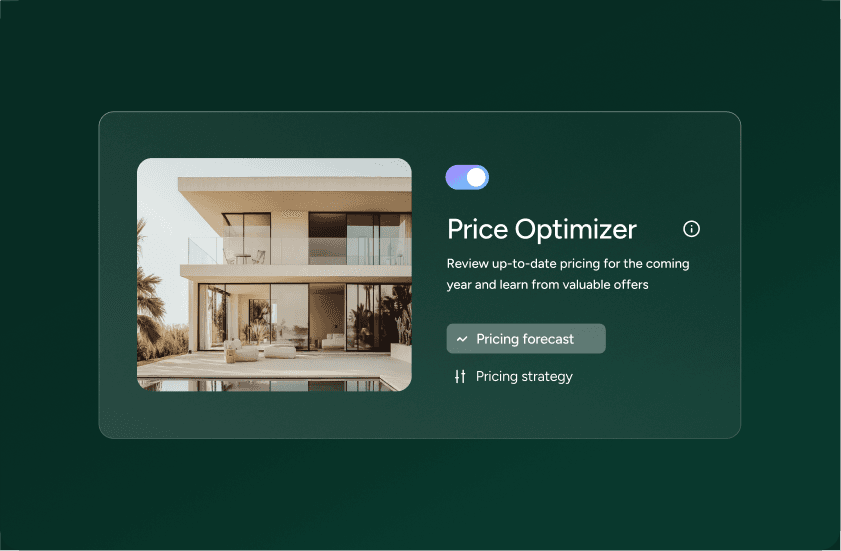
Guesty PriceOptimizer™ replaces native tools to protect margins. It uses real-time market data, event scraping for local concerts, and historical trends to suggest rates that keep the property competitive while filling the calendar at the highest price the market allows.
Implement four strategies to increase occupancy
1. Improve algorithm rankings with strikethrough pricing
The Airbnb algorithm rewards discounts. Running strategic promotions, such as a New Listing discount, displays a strikethrough price. This increases click-through rates and signals value to the algorithm, which improves search placement.
2. Diversify distribution across multiple channels
Platform dependency is a significant risk. If one platform has a glitch or algorithm change, occupancy can drop to zero.
Listing on multiple channels like Vrbo and Booking.com mitigates this risk. The Guesty Channel Manager™ centralizes calendars and prevents double-bookings by instantly blocking dates across all platforms when a booking occurs.
3. Remove booking barriers with professional protection
High security deposits reduce conversion rates. Guests are often unwilling to tie up large sums of money, which drives them toward hotels.
Replacing manual deposits withGuesty Damage Protection™ removes this financial barrier for guests while providing comprehensive property protection.
| Metric | With manual security deposit | With Guesty Damage Protection |
|---|---|---|
| Guest friction | High (large upfront hold) | Low (nominal flat fee) |
| Operational effort | High (manual collection/refunds) | Low (automated in-platform) |
| Avg. occupancy impact | Baseline | ~16% relative increase |
4. Automate communications to improve response times
Slow responses cost bookings. Airbnb rewards hosts who answer inquiries quickly. Faster response times lead to higher conversion and better search rankings. Guesty Lite™ allows hosts with 1–3 units to automate standard replies. This ensures inquiries are handled immediately, improving conversion without requiring constant manual monitoring.
Review benchmark data by U.S. region
| U.S. region | Peak season occupancy | Off-season occupancy | Market character |
|---|---|---|---|
| Florida coast | 75% – 85% (winter/spring) | 40% – 50% (late summer) | High seasonality; heavy competition. |
| Mountain/ski (CO/UT) | 80% – 90% (winter) | 35% – 45% (spring/fall) | Extreme peaks; high nightly rates. |
| Urban (NYC/Chicago/LA) | 65% – 75% | 55% – 60% | Steady year-round; business travel. |
| Midwest/rural | 50% – 60% (summer) | 25% – 35% (winter) | Weekend-driven; lower volume. |
Protect your occupancy with the right tools
Guesty Lite™ (1–3 listings) provides essential automation for small hosts managing communications and pricing. Guesty Pro™ (4–499 listings) supports growing portfolios with advanced revenue management, multi-channel distribution, and detailed analytics. Guesty Enterprise™ (500+) delivers custom workflows and dedicated support for large-scale operations.