TL;DR: The AI tools landscape for vacation rental automation has shifted. Individual point solutions for messaging, pricing, and operations still exist, but the operators gaining the most ground in 2026 are running native AI inside their PMS — where agents share context, execute work autonomously, and draw from real STR operational data. This guide breaks down what to look for in each category and why the fragmented-tools approach is becoming a liability.
Why is the AI tools conversation changing in 2026?
Two years ago, the question was “which AI tools should I add to my stack?” In 2026, the question is “why am I still running five disconnected tools when my PMS should be handling this natively?”
The shift happened because bolting individual AI tools onto your operation creates a problem that gets worse as you scale. Your messaging bot doesn’t know what your pricing tool just flagged. Your task automation can’t read your guest conversations. Your fraud detection runs on generic rulesets instead of your actual reservation data. Each tool is smart in isolation. Together, they’re a fragmented stack that still depends on you to connect the dots.
The operators pulling ahead aren’t collecting more tools. They’re consolidating into platforms where AI is native, contextual, and capable of executing work end to end.
Here’s what that means across every category that matters.
AI guest communication tools
Guest communication is the highest-volume, most time-sensitive part of your operation. It’s also where the gap between bolted-on tools and native AI shows up fastest.
What should you look for in AI guest communication tools?
The point-solution approach: Standalone chatbots and messaging assistants sync with your calendar and answer common questions — Wi-Fi passwords, check-in times, parking directions. Some learn your house rules and draft replies for you to approve. They work, up to a point. But they operate from scripts or general hospitality data, which means anything contextual — “Can I check in two hours early tomorrow?” — bounces back to you for a manual response.
What to look for instead:
- Execution, not just drafts. Does the AI send the reply when it’s confident, or does every message still need your approval?
- Live reservation data. Does the tool read the actual check-in time, the actual policy, the actual availability for that date? Or is it working from a static FAQ?
- Sentiment detection with action. Can it read frustration in a message and adjust its tone — or escalate to your team — without you having to flag it?
- Cross-system awareness. When a guest reports a broken appliance, can the messaging tool create a maintenance task directly? Or does that require a separate system?
- Multi-language accuracy. Not just translation, but contextual fluency — maintaining tone, sentiment, and property-specific details across languages.
An agentic PMS handles all of this natively. The communication agent reads the message, checks your reservation data, replies in the guest’s language, adjusts for sentiment, and creates an operational task if needed — all in one pass, all from the same data layer.
Best AI tools for guest messaging and communication
Guesty messaging assistant (ReplyAI)
This tool pulls data directly from listings to generate authentic responses in seconds. It uses conversation history to maintain your specific tone. Use Guesty® to automate these interactions across every channel.
HostBuddy AI
This standalone chatbot syncs with calendars to answer availability questions. It works for small portfolios but requires oversight to prevent errors in property details.
Besty AI
Besty learns house rules and recommendations to draft replies for operator approval. This keeps a human in the loop for every message sent to the guest.
AI revenue management
Setting rates manually or on fixed schedules is leaving money on the table in a market that shifts daily. But not all AI pricing tools are equal.
What should you look for in AI revenue management?
- Real-time execution, not just recommendations. Does the tool adjust rates and push them live across channels, or does it surface a suggestion for you to act on?
- Domain-specific training data. Is the pricing model trained on actual STR booking patterns across hundreds of thousands of listings, or on generic market data?
- Revenue beyond nightly rates. Can the system detect upsell opportunities — early check-in, late checkout, mid-stay cleaning — and surface them at the right moment in the guest journey?
- Connection to demand signals across the PMS. Does pricing respond to occupancy patterns, booking velocity, and competitor movement in real time?
When pricing lives inside an agentic PMS, the revenue agent doesn’t just adjust rates. It shares context with communication, operations, and finance — so a guest asking about extending their stay gets an instant quote at the right rate, without anyone manually checking availability or calculating the price.
Best AI revenue management tools
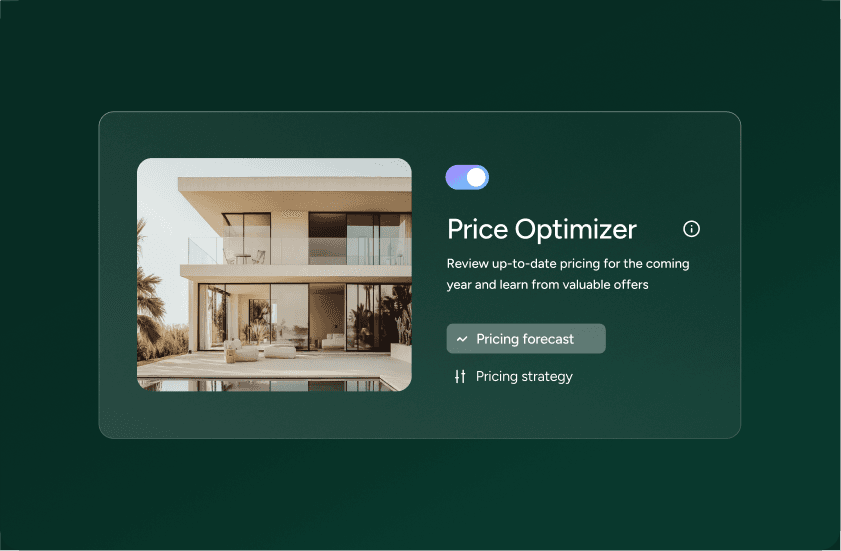
Guesty PriceOptimizer™
Precision matters for profitability. This tool uses AI-driven strategies to find lost income by forecasting demand. Deploy Guesty PriceOptimizer™ to protect margins during slow seasons.
PriceLabs and beyond
These standalone tools offer massive data sets for hyper-local strategies. Many operators use these when they want to spend time manually tweaking individual property curves.
AI task management tools
Cleaning failures, missed maintenance, and slow response to guest issues are the silent killers of your review scores. Most operators manage tasks through a combination of spreadsheets, messaging apps, and memory.
What should you look for in operations and task automation?
Boost your short term rentals today
- AI task creation from guest messages. When a guest reports an issue, does the system create a task automatically — with the right property, category, and urgency — or does your team still manually triage the inbox?
- Native connection to your reservation calendar. Does the task system know when the next guest arrives, or is it working from a synced copy that might be minutes behind?
- One-click assignment, not manual dispatching. Pre-filled tasks with all the context your team needs to act immediately.
In an agentic PMS, the communication agent detects a maintenance issue in a guest message, creates the task, and serves it ready for assignment — all before your team opens the dashboard. The operations layer doesn’t need a separate tool because it shares the same data as your inbox and your calendar.
Cleaning failures kill reviews, especially when a cleaner misses a same-day turnover due to sync failures. Operators often struggle with the transition between the booking and the cleaning schedule.
Best AI task management tools for short term rentals
Native task management vs. third-party integrations
Native tools live inside your software and see bookings instantly. Third-party tools rely on APIs or iCals, which often cause sync delays that hurt your rankings. Native systems prevent missed cleanings by removing this lag.
Turno
Turno is a marketplace for cleaners that automates scheduling and payments. It is a solid choice for finding vendors quickly if you do not have a dedicated local team.
Operto for smart lock and energy automation
This tool integrates with locks to send unique entry codes to guests. It also manages thermostats to lower utility bills when the property is empty, protecting your bottom line.
The security frontier: AI guest screening and fraud prevention
Security is a major risk for US property managers. Fraudulent payments and party guests can destroy a property in one night, and manual screening is too slow to stop them.
The security frontier: AI guest screening and fraud prevention
Fraudulent bookings and problem guests are a financial and operational risk that grows with your portfolio. Manual screening doesn’t scale, and generic fraud tools miss patterns specific to short-term rentals.
What should you look for in AI guest screening and fraud prevention?
- Reservation-level fraud detection. Does the system analyze payment patterns against actual booking data, or does it apply generic fraud rules?
- Automated ID verification. Can it run background checks and flag high-risk profiles before arrival without adding steps to your workflow?
- Connection to your financial data. When a payment anomaly is detected, does the system hold the transaction and alert your team — or just log it for you to find later?
Guesty Verify and Guesty PayProtect™
Risk mitigation is now automated. Guesty® Verify performs background checks and ID validation silently to flag fake profiles before arrival. Combine this with Guesty PayProtect™ to detect fraudulent payment patterns and block high-risk transactions before they hit your account. For any property using smart locks or cameras, include clear disclosure in your listing description and house rules to meet platform requirements.
Why does native AI outperform a fragmented stack?
This is the question underneath every tool comparison. Here’s how the two approaches differ in practice:
| Fragmented AI tools | Native agentic PMS | |
| Data accuracy | Variable — depends on API sync timing and iCal reliability | High — single source of truth, real-time data |
| Cross-system awareness | None — each tool operates in isolation | Full — every agent shares context with every other |
| Execution capability | Most suggest; you still approve and click | Agents execute within rules you define |
| Setup and maintenance | Multiple dashboards, multiple vendor relationships | One platform, one interface |
| Training data | Generic hospitality or broad market data | Domain-specific, trained on 500K+ active STR listings |
| Scaling cost | Per-tool fees compound as portfolio grows | Native capabilities scale with the platform |
The gap widens as you grow. At 10 listings, individual tools are manageable. At 50, you’re spending as much time managing your tech stack as managing your properties. At 200, the fragmentation becomes the bottleneck.
How do you transition from individual tools to an agentic platform?
Don’t rip everything out on day one. Start with the highest-volume pain point — for most operators, that’s guest communication.
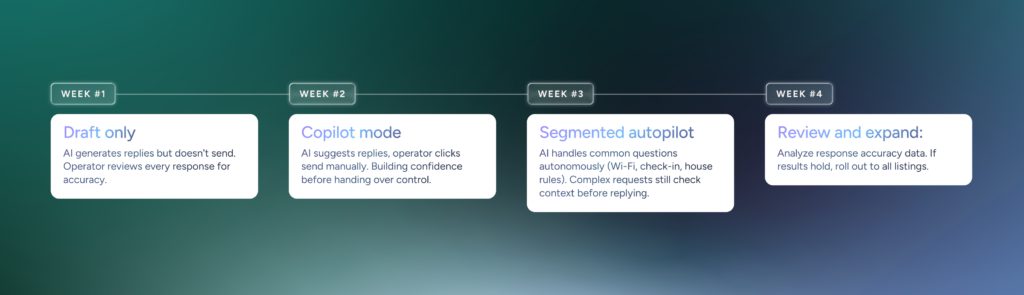
Week one: Let the AI draft responses without sending. Review every reply for accuracy on property-specific details — parking, trash schedule, access codes.
Week two: Switch to supervised mode. The AI suggests, you approve and send. Build confidence in how it handles edge cases.
Week three: Activate autonomous replies for high-confidence message categories — Wi-Fi, check-in directions, amenity questions. Monitor escalations.
Week four: Expand to full activation across listings. Review response data, adjust confidence thresholds, and extend to revenue and operations agents.
The phased approach lets you validate accuracy before trusting execution. Every agent can be dialed up or down based on what you see in the data.