Here’s something nobody in the industry wants to say out loud: the AI race is basically over. Every PMS has it. Every platform is shipping agents, copilots, assistants, optimizers. The technology is real, and most of it works reasonably well. If your only question is “does this platform have AI?” the answer is yes. Everywhere. That’s no longer a differentiator.
So what is?
Think about what happens when two platforms both deploy a messaging agent. One is trained on a broad language model with general hospitality content scraped from the internet. The other is trained on millions of actual guest conversations across hundreds of thousands of active STR listings — real questions, real complaints, real check-in logistics, real sentiment patterns in real markets.
Both agents can draft a polite reply. Only one knows how guests in Barcelona typically ask about early check-in versus how guests in Austin do it. Only one recognizes that a message mentioning “the unit next door” in a multi-unit building carries different operational implications than the same phrase in a standalone cabin. Only one understands the difference between frustration about a late response and frustration about a maintenance issue, and adjusts both tone and action accordingly.
The AI is the same. The data is everything.
Why is AI becoming a commodity in property management?
Because the underlying technology is increasingly available to everyone. Large language models are accessible through APIs. Generative AI frameworks are well-documented. Any engineering team with enough resources can build a messaging agent, a pricing recommendation tool, or a listing description generator.
And they are. Across the industry, platforms that had no AI 18 months ago now ship features that look remarkably similar on a demo screen. Reply suggestions, dynamic pricing dashboards, automated descriptions. The capability gap between platforms is narrowing fast.
But here’s the reframe most vendors won’t offer you: the gap that’s widening is the data gap.
AI trained on thin data produces thin output. It hedges more, hallucinates more, defaults to generic responses more. AI trained on deep, domain-specific data produces output that reflects how the industry actually operates — not how a language model thinks it should.
That’s not a product pitch. It’s a data science argument. Fragmentation is the enemy of good AI, because fragmented tools produce fragmented data, and fragmented data trains mediocre models. Connected systems produce connected data. Connected data trains smarter agents.
What makes STR operational data different from generic training data?
Generic hospitality data tells an AI that guests sometimes ask about check-in times. Operational data from 500,000+ active listings tells an AI that check-in questions spike at 2pm on arrival day, that the phrasing differs by market and language, that a guest asking “can I come early” on the morning of check-in has different intent than one asking three days out, and that the right response depends on cleaning schedules, prior guest checkout status, and your specific early arrival policy.
That level of specificity doesn’t come from scraping the internet. It comes from 13 years of running real STR operations — real reservations, real guest interactions, real pricing decisions, real maintenance workflows, real financial reconciliation — across 100+ countries and every major booking channel.
The data advantage compounds in three ways:
Depth of pattern recognition
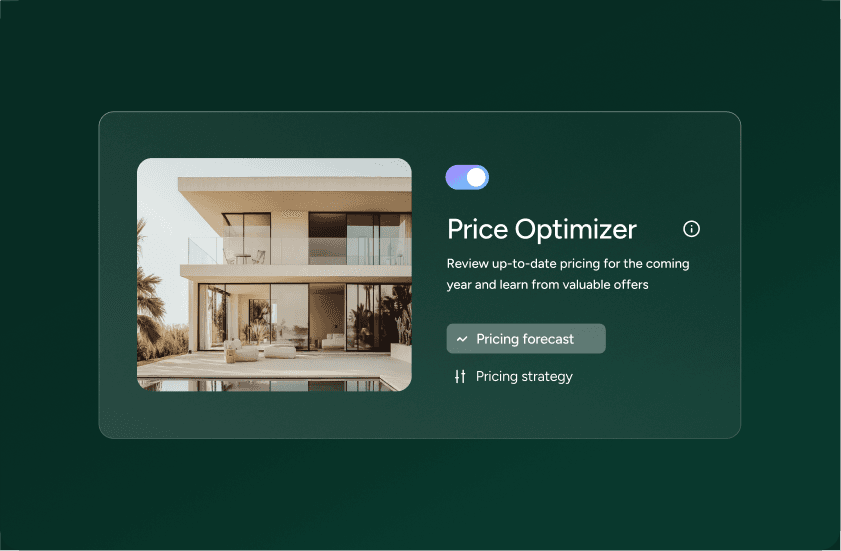
A pricing agent trained on hundreds of thousands of listings across diverse markets recognizes demand signals a smaller dataset would miss entirely — micro-seasonal patterns, event-driven spikes, competitor pricing behaviors that only emerge at scale.
Contextual accuracy in communication
A messaging agent trained on millions of real guest conversations doesn’t just generate grammatically correct replies. It understands the operational subtext of what guests are asking and how to respond in a way that resolves the issue, not just acknowledges it. That’s the difference between “let me check on that” and actually checking, then answering.
Connected intelligence across functions
Boost your short term rentals today
When communication, pricing, operations, finance, and review data all feed into the same training environment, the agents get smarter together. The pricing agent learns from the booking patterns that the communication agent surfaces. The reviews agent identifies sentiment trends the operations agent can act on. The data compounds because the system is connected.
Why does data quality matter more than data volume?
Volume without structure is noise. An AI trained on a million chaotic data points from disconnected systems produces confidently wrong output — and that’s worse than no AI at all.
Data quality in property management means three things:
Clean. Consistent naming conventions, accurate reservation records, reliable financial data. If your listings are stored differently across three platforms, your AI is training on contradictions.
Current. Real-time data, not yesterday’s sync. A pricing agent working from a two-hour-old competitor snapshot is already making outdated recommendations. A communication agent pulling from a cached availability calendar might confirm a booking that no longer exists.
Connected. Every data point accessible to every agent that needs it. Guest sentiment from reviews informing pricing decisions. Payment anomaly patterns informing booking risk scores. Communication patterns informing operational task prioritization.
This is where the platform architecture matters as much as the data itself. A connected PMS where every function operates from the same data layer creates a compounding intelligence loop. Each agent’s output becomes another agent’s input. The system gets smarter with every interaction, every booking, every resolved complaint.
A fragmented stack — even one with individually excellent tools — can’t replicate this. The data sits in silos. The AI trains on fragments. And the operator is the one manually connecting what the tools cannot.
What does this mean for operators choosing a platform in 2026?
The demo is no longer the decision point. Every demo looks good. Every AI feature performs well in a controlled walkthrough.
The questions that actually matter are harder to answer from a sales deck:
- What is this AI trained on? Generic hospitality content? A third-party language model? Or operational data from hundreds of thousands of real STR properties?
- How connected is the data layer? Do the communication, pricing, operations, and finance functions share the same real-time data? Or are they separate tools with separate databases?
- Does the AI learn from my operation over time? As more guest conversations, pricing outcomes, and operational patterns accumulate in the system, does the AI get better at serving my specific portfolio?
- What happens to my data quality if I add more tools? Does each new integration increase fragmentation, or does the platform maintain a single source of truth?
The operators who will outperform over the next three years aren’t the ones who adopted AI first. They’re the ones whose AI was trained on the deepest, cleanest, most connected dataset. That’s a structural advantage you can’t replicate by shipping more features.
Where is the data race headed?
AI-driven discovery is already reshaping how travelers find and book properties. Your listings aren’t just being evaluated by humans scrolling through photos anymore. They’re being parsed by AI agents that weigh your data, your reviews, your pricing patterns, and your response quality.
Operators with clean, structured, continuously updated data get surfaced. Operators with fragmented, inconsistent data get buried. Data quality isn’t just an operational advantage anymore. It’s a distribution advantage.
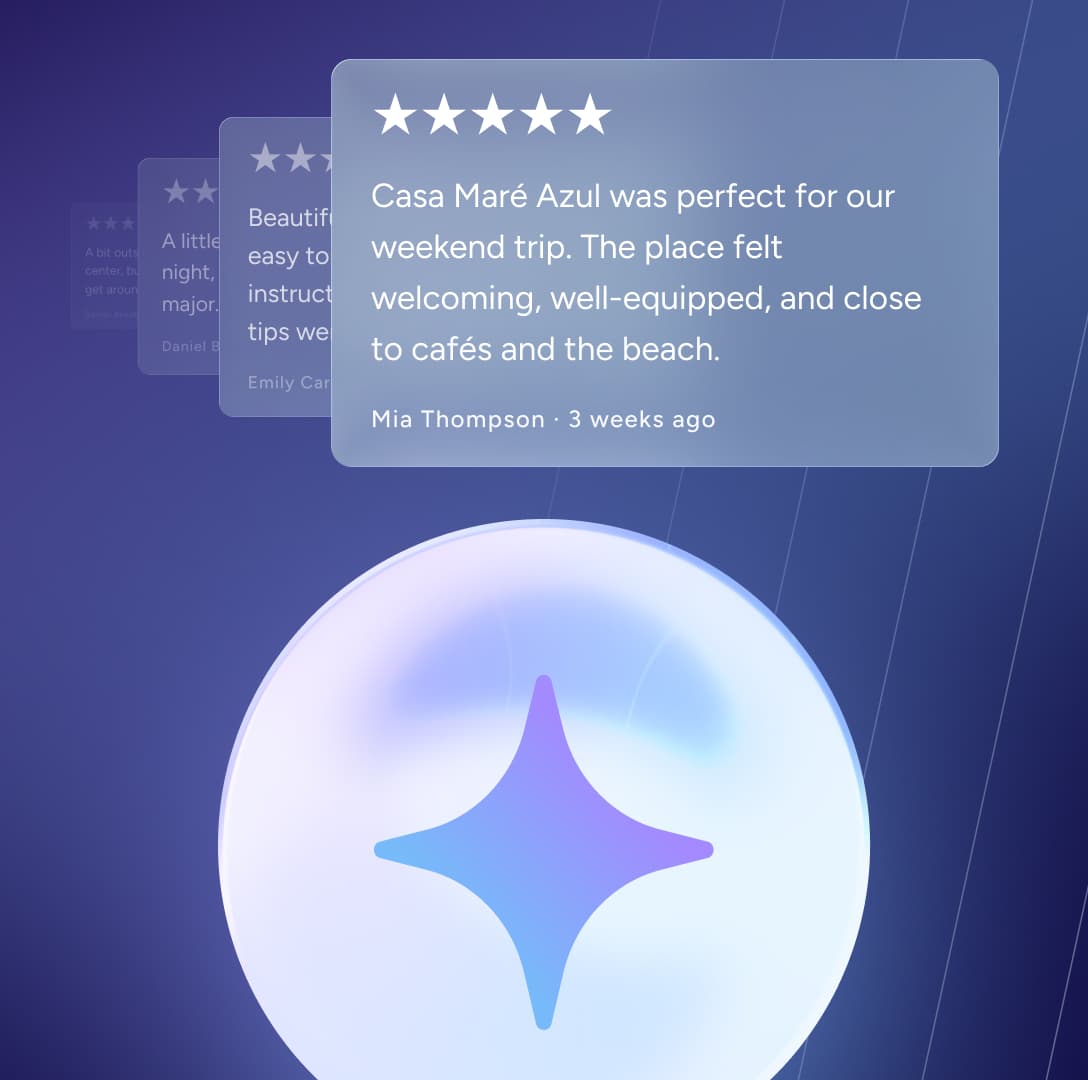
Reviews are a leading indicator. Among Guesty customers, a new 5-star review lands every 30 seconds. Each one is machine-readable intelligence that AI discovery platforms use to evaluate listing quality. Sentiment, volume, response speed, response quality — these are becoming the signals that determine whether a traveler’s AI assistant recommends your property or skips it entirely.
The AI arms race in short-term rentals is effectively over. The data race is just starting. And the winners won’t be the platforms that ship the most features. They’ll be the ones whose data makes every feature smarter.