Launching a short-term rental (STR) business once meant listing exclusively on Airbnb. By 2026, an Airbnb-only strategy creates a significant business risk. If the platform changes its search algorithm or increases guest fees, your revenue can drop instantly. Diversifying bookings protects your income, even though managing multiple apps increases the daily workload. This guide breaks down the most viable Airbnb alternatives for small hosts and addresses how to bridge the operational gap between them.
TL;DR
- An Airbnb-only strategy creates revenue vulnerability — algorithm changes or fee increases can cut your income overnight.
- Vrbo attracts families and longer stays; Booking.com captures international and business travelers; Furnished Finder targets 30+ day mid-term stays.
- Direct booking websites eliminate commission fees entirely and give you full ownership of guest data.
- Managing multiple platforms without real-time API synchronization creates double-booking risk — iCal delays of up to 30 minutes are enough for overlapping reservations.
- Payment processing shifts from platform-managed (Airbnb) to host-managed (Vrbo, Booking.com, direct) as you diversify — automate this or lose hours per week.
Why small hosts look beyond Airbnb?
Airbnb provides high booking volume but limits operator control. Two major issues impact small businesses. First, in-app communication rules prevent hosts from building a direct guest database for repeat bookings. Second, guest service fees often exceed 14%, which can make your property uncompetitive compared to other platforms. Moving off-platform gives you control over pricing and guest data, shifting your role from a host to an operator.
Top vacation rental platforms for small hosts
If you manage 1-5 properties, focus on platforms where your target guests book rather than trying to be everywhere at once.
1. Vrbo (The family-friendly powerhouse)
Vrbo is the leading U.S. alternative for whole-home rentals. It excludes shared spaces, which attracts families and groups who book longer stays further in advance. This results in a higher average booking value. When you use professional management software, Vrbo requires you to be the Merchant of Record, meaning you are responsible for processing guest payments directly.
We’ve compared Airbnb with Vrbo in this guide
2. Booking.com (Global reach, higher complexity)
Booking.com provides massive traffic for vacation rentals, especially from international and business travelers. It relies on an instant-booking model. Operators often find this channel complex because it may pass along unverified credit card data. Hosts frequently need to verify payment methods manually to avoid revenue loss from invalid cards.
Learn more about the difference between hosting on Booking.com & Airbnb in this guide
3. Hopper Homes (The mobile-first millennial choice)
Hopper has moved from flight bookings into the vacation rental market. It is a mobile-driven app that attracts younger travelers who value price stability. The platform uses features like price freezes and loyalty rewards to maintain high booking volume.
Niche alternatives for specialized properties
Specialized platforms often provide better guest filtering and higher margins for specific property types.
4. Furnished Finder (The mid-term stay leader)
Furnished Finder is the standard for stays of 30 days or more. It targets traveling nurses and corporate professionals, reducing the churn of nightly bookings. Instead of per-booking commissions, hosts pay an annual listing fee, which increases your take-home margin.
5. Marriott Homes & Villas (For luxury listings)
Marriott offers a curated platform for high-end properties. It provides access to millions of Bonvoy loyalty members. The barrier to entry is higher, requiring professional management standards, but it attracts top-tier guests with larger travel budgets.
Boost your short term rentals today
6. Expedia
Expedia functions as a high-volume travel agency. It brings in travelers who often expect hotel-level service and automated check-in procedures. Guests on this platform may not check in-app messages, so clear, automated communication is necessary for smooth operations.
7. Direct booking website
Your own website is the most profitable channel. It eliminates 15-20% in channel commissions and guest fees. Guesty Websites™ simplifies the setup, allowing you to launch a professional site without a developer. The system syncs your rates and availability automatically across all channels. Most importantly, you retain all guest data for future marketing and repeat business.
The hidden challenges of diversifying your channels
Listing on multiple platforms increases the risk of double bookings and creates payment friction.
Handle payments outside the Airbnb “safety net”
Airbnb handles all guest payments on their platform. On Booking.com or your own site, you process the money. Manual payment collection is a major friction point. Hosts often waste hours entering card details or sending links. GuestyPay™ addresses this with a secure, integrated payment processor for short-term rentals. It automates payment flows, handles deposits, and manages chargebacks to protect your revenue.
Avoid the double-booking nightmare
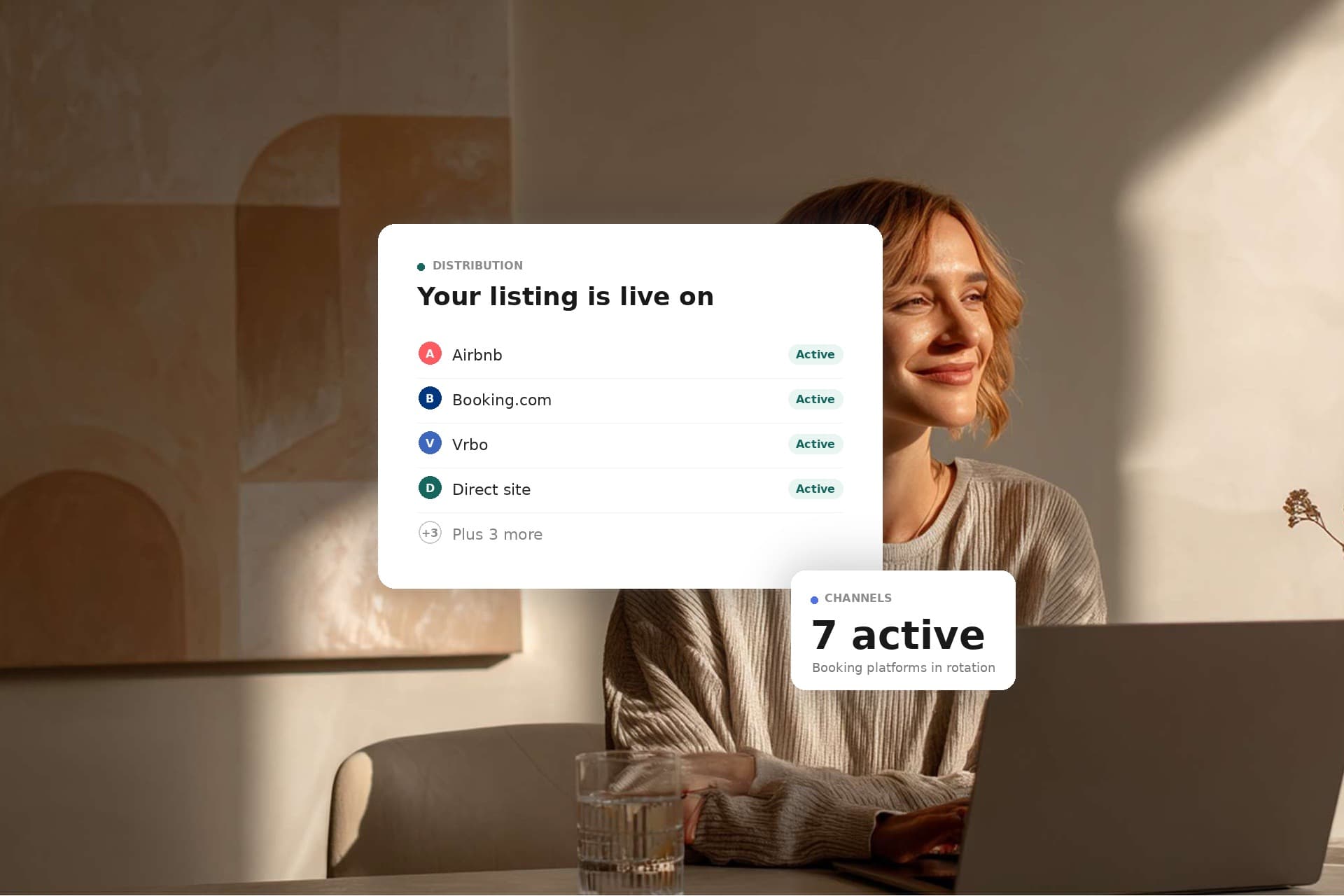
Managing 1-5 units across multiple sites requires real-time synchronization. A 30-minute delay in calendar syncing is enough time for an overlapping reservation to occur. Guesty Lite™ serves as a central source of truth for small hosts. When a booking occurs on one platform, the software instantly blocks those dates on all others, removing the risk of manual errors and cancellations.
Compare host fees and guest demographics
| Platform | Host fee % | Guest fee % | Primary audience | Payment responsibility |
|---|---|---|---|---|
| Airbnb | 3% (typically) | 14%+ | Solo, couples, urban travelers | Platform |
| Vrbo | 5% + CC fees | 6–15% | Families, groups, vacation towns | Host (with PMS) |
| Booking.com | 15% | 0% | International, business, hotel-seekers | Varies (often host) |
| Direct booking | 0% | 0% | Repeat guests, referrals | Host |
Transition to a multi-channel strategy without the stress
1. Step 1: Optimize your base listing. Ensure your photos and descriptions are platform-neutral. Remove any text that mentions Airbnb specifically.
2. Step 2: Choose one secondary channel. For most U.S. hosts, Vrbo is the most logical next step. Learn their payment and interface structure before adding a third channel.
3. Step 3: Centralize your operations. Use the Guesty Channel Manager™ to automate rates and availability. Updating a price in one place will push that change to Airbnb, Vrbo, and your direct site simultaneously.
Scale your multi-channel strategy
Guesty Lite™ (1–3 listings) provides essential automation for hosts diversifying beyond Airbnb. Guesty Pro™ (4–499 listings) supports growing portfolios with API-integrated channel management, automated payments, and multi-platform reporting. Guesty Enterprise™ (500+) delivers custom workflows and dedicated support for operators managing inventory across multiple channels and markets.