Most small hosts start their vacation rental journey by accident. This often begins with a spare room, a secondary property, or an inherited family home. Many operate without a formal business plan, treating the venture as a high-stakes hobby. In the U.S. market, where local regulations are tightening and guest expectations are high, a passive approach leads to burnout. A vacation rental business plan provides the structure needed to manage properties professionally while maintaining a primary career.
TL;DR
- A business plan prevents operator fatigue and is required for bank financing — treat your STR as a business from day one.
- Your executive summary should define whether you’re a lifestyle host (mortgage coverage) or building a scalable management company.
- Market analysis means reading competitor one-star reviews to identify service gaps you can fill.
- Start with professional PMS software to avoid technical debt from migrating out of basic tools later.
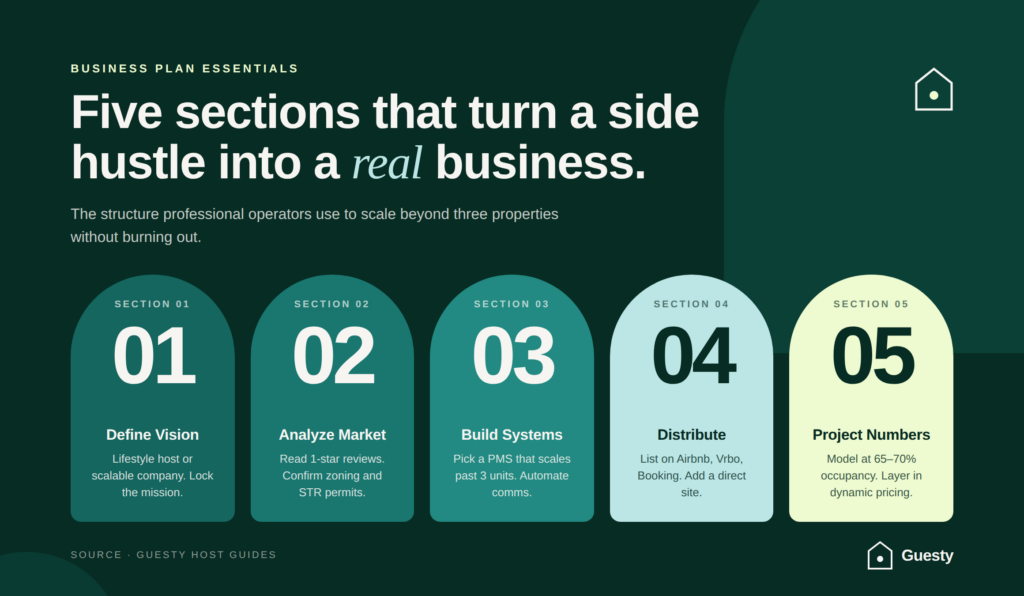
- Financial projections should use 65–70% occupancy as a conservative baseline for year-one planning.
- Reduce platform dependency by building a direct booking strategy alongside your OTA presence.
Recognize why small hosts need a business plan
A business plan serves as a roadmap to prevent operator fatigue. It is also a requirement for securing bank loans. When managing one property, manual tasks like sending check-in instructions or updating calendars are manageable. At three properties, these tasks become a bottleneck that consumes weekends. A plan shifts the focus toward systems. This ensures that as revenue grows, the workload remains predictable and manageable.
Write an executive summary to define your vision
The executive summary defines the scope of the business. Determine if the goal is to cover a mortgage as a lifestyle host or to build a scalable property management company.
Draft mission statements and objectives
Mission statements must be specific. Aim for a target like “providing tech-forward, seamless lodging for business travelers in downtown Austin.” Set measurable objectives, such as achieving a 75% occupancy rate in the first year or maintaining a 4.9-star rating across all platforms.
Identify your unique selling proposition
Success in a crowded market requires more than competing on price. A unique selling proposition (USP) makes a guest choose your property over a hotel or a cheaper alternative. This could include features like pet-friendly luxury with a fenced-in yard or high-speed Wi-Fi for remote workers.
Conduct a market analysis for your niche
Profitability in the U.S. vacation rental market depends on local factors. A plan for a mountain cabin will not apply to a city condo.
Research local competition
Analyze competitor pricing and identify service gaps. Read the one-star reviews of nearby properties. If guests complain about slow communication, poor cleaning, or a lack of local info, use these gaps as opportunities to capture market share.
Confirm local regulations and compliance
U.S. cities, including San Diego and New York, are implementing strict short-term rental (STR) laws. A business plan must account for these operational requirements:
- Zoning laws: Confirm the property is in a zone that allows STRs.
- Occupancy taxes: Plan for the collection and payment of state and local transient occupancy taxes.
- Permitting: Include the cost and time required to obtain city permits in the startup timeline.
Set up operations and management systems
This section details daily operations. The objective is to transition from a fixer to a manager.
Choose between outsourcing and DIY
Decide which tasks to handle personally and which to delegate. Most hosts eventually outsource cleaning and maintenance. High-performing operators also reduce their mental workload by using technology to handle routine tasks.
Automate the guest experience
Manual tasks act as anchors that slow down a small business. Guesty Lite™ is built for hosts with 1 to 4 listings to automate repetitive parts of the job, such as sending check-in instructions or requesting reviews. Automating the majority of guest messages ensures a professional experience without requiring constant phone monitoring.
Implement professional guest communication
Hosts with full-time jobs cannot always respond to inquiries within minutes. Because booking algorithms prioritize fast response times, many operators use Guesty’s 24/7 Guest Communication Services. This service handles inquiries, booking requests, and routine guest questions around the clock, allowing the host to focus on revenue and growth.
Select your technology stack for future growth
Small hosts often make the mistake of using basic tools that they must eventually replace. Migrating data from a basic channel manager to a professional platform later creates unnecessary technical debt.
| Feature | Starter tools (iCal-based) | Professional PMS (Guesty) |
|---|---|---|
| Sync reliability | iCal (slow, frequent double bookings) | Full API (real-time, instant sync) |
| Channel depth | Basic (price/dates only) | Deep (content, non-refundable rates, taxes) |
| Guest interaction | Multiple separate apps | Unified inbox for all channels |
| Direct bookings | Often requires a 3rd party site | Built-in branded booking website |
| Scaling potential | Hard limit at 1-3 properties | Scales from 1 to 500+ properties |
Boost your short term rentals today
Starting with a professional PMS allows you to manage complex tasks. This includes offering non-refundable rates on Booking.com or managing local tax compliance that basic tools cannot support.
Build a marketing and distribution strategy
A business plan should reduce dependency on a single platform. Relying entirely on Airbnb for bookings creates significant revenue risk.
List on multiple booking channels
A robust plan includes a presence on Airbnb, Vrbo, and Booking.com. This ensures that if one platform changes its algorithm, your total revenue remains stable.
Create a direct booking strategy
The goal of a professional host is to own the guest relationship. By using a direct booking website, you avoid high commission fees and can market directly to past guests. This turns a single visit into a repeat booking.
Outline financial projections and profitability
A business plan requires accurate math. Account for fixed startup costs like furniture, permits, and smart locks alongside variable operating expenses like utilities, cleaning, and software subscriptions.
Use dynamic pricing for revenue management
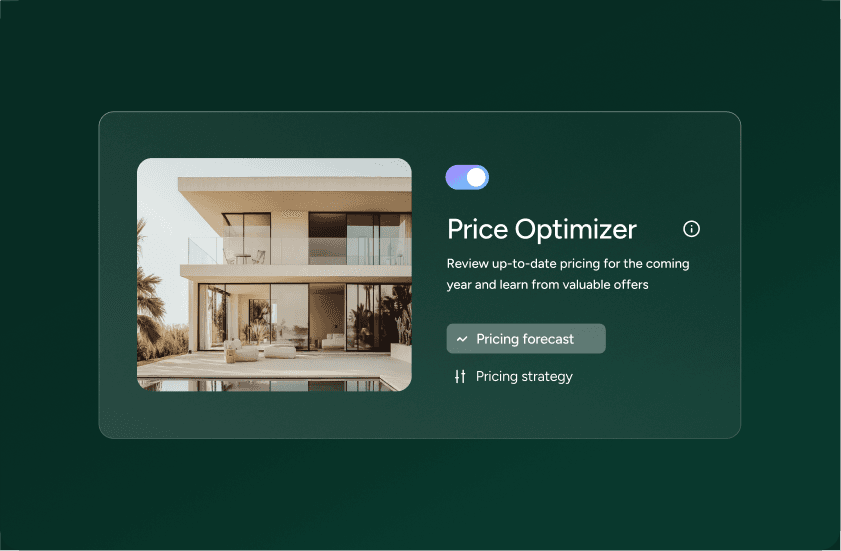
Static pricing leads to lost revenue. Use a tool like Guesty PriceOptimizer™ to adjust rates based on local demand and seasonality. This prevents underpricing during major events and maintains occupancy during slow periods.
Plan for growth from one to ten properties
As a portfolio grows, operational needs change. The transition from four properties to five is a major milestone. This shift typically marks the move from Guesty Lite™ (1–3 listings) to Guesty Pro™ (4–499 listings), which provides access to multi-unit management, advanced analytics, and detailed owner reporting.These tools significantly reduce the per-property management overhead as your portfolio scales.
See a sample business plan in action
A plan does not need to be 40 pages to be useful. Below is a condensed one-page business plan for a fictional small host, “Cedar & Pine Stays,” running 2 cabins near Asheville, NC. Use it as a starting template — swap in your own market, numbers, and goals.
Cedar & Pine Stays — sample plan
Operator: Single host, full-time marketing job
Portfolio: 2 cabins (1 BR and 2 BR) in Black Mountain, NC
Year-one goal: 68% occupancy, 4.9-star rating, $74,000 combined gross revenue
Executive summary
Cedar & Pine Stays offers pet-friendly cabin rentals for remote workers and weekend travelers visiting the Asheville area. The business covers the mortgage on both cabins, builds a second income stream, and lays the groundwork for a 3rd property in year 2.
Unique selling proposition
Fast Wi-Fi (300 Mbps), fenced yards for pets, and a 5-minute drive to downtown Black Mountain — three things competitor listings in the area consistently lack, based on a review of 1-star feedback on nearby cabins.
Market analysis
- Local competitor ADR: $185–$240 in peak season, $110–$160 off-season
- Top 3 complaints in nearby 1-star reviews: slow check-in communication, outdated photos, unclear pet policies
- Black Mountain requires a short-term rental permit ($350 annual fee) plus a 6% local occupancy tax on top of NC state sales tax
Operations
- Cleaning outsourced to a local turnover service at $95 per turn
- On-call handyman at $65 per hour for maintenance
- Guest messaging automated through ReplyAI inside Guesty Lite™
- Nightly rates adjusted weekly with PriceOptimizer
- Smart locks with codes that rotate per booking
Technology stack
Guesty Lite™ handles channel sync, the Unified Inbox, automated messaging, dynamic pricing, and a branded direct booking site — all from one place. Smart locks and noise sensors round out the on-property tech.
Marketing and distribution
Year 1 channels: Airbnb, Vrbo, and Booking.com. Direct booking site soft-launches in month 6, with the goal of 15% of bookings coming direct by month 12. Past guests receive a single follow-up email 60 days after checkout with a 10% return rate offered through the direct site.
Financial projections (year 1)
| Line item | Amount |
|---|---|
| Gross revenue (both cabins) | $74,000 |
| Channel commissions (blended ~12%) | ($9,200) |
| Cleaning and maintenance | ($11,400) |
| Software, permits, and local taxes | ($4,800) |
| Net operating income (pre-mortgage) | ~$48,600 |
Growth plan
Add a 3rd cabin in year 2, funded by year-one cash flow plus a small business loan. Once the portfolio reaches 5 listings, move from Guesty Lite™ to Guesty Pro™ for multi-unit management, advanced analytics, and owner reporting.