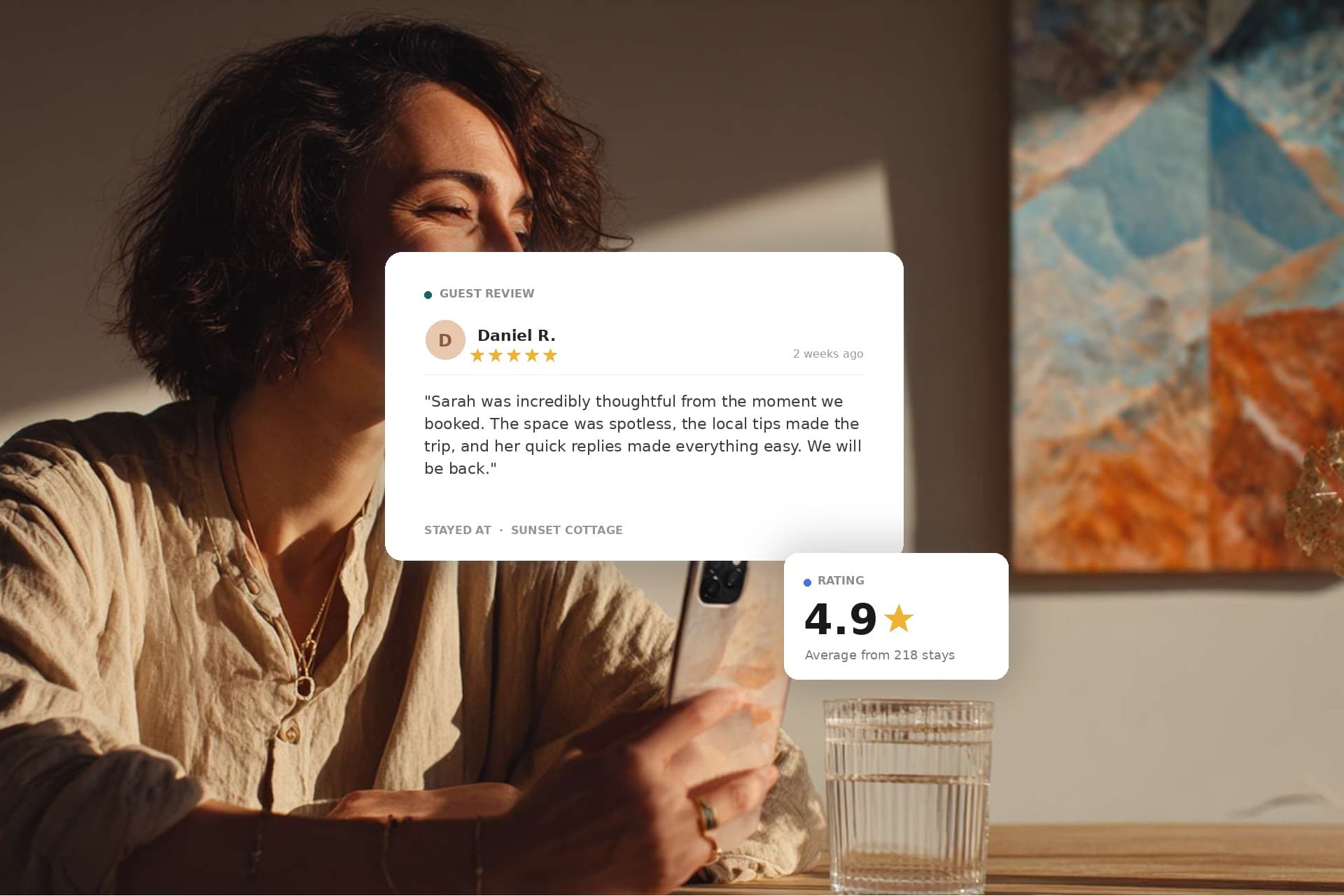
Writing guest reviews is the final task at the end of a stay, but in the competitive short-term rental market, it’s also a strategic lever for growth. Leaving a review signals to platform algorithms that you are an active operator, builds a paper trail that protects your property, and creates a bridge to your next direct booking.
TL;DR
- Leaving guest reviews signals to platform algorithms that your listing is actively managed, neglecting them causes slow search ranking decline.
- Focus every review on three pillars: communication responsiveness, rule compliance, and property condition at checkout.
- Use template pools with variation to keep your review profile looking organic rather than automated.
- Set a 2–3 day delay before auto-reviews trigger — this gives your cleaning team time to flag hidden damage before you endorse a guest.
- Timing matters with difficult guests: submit your review at the end of the 14-day window to limit their opportunity for retaliation.
- Convert proven guests from OTA bookings to direct bookings with a post-review coupon code.
What is the operational value of host reviews?
The review ecosystem is a primary driver of platform performance. Platforms like Airbnb and Vrbo reward active hosts — consistently reviewing your guests tells the algorithm that your listing is managed by a responsive operator. Neglecting these reviews can lead to a slow decline in search rankings. Detailed feedback also helps fellow hosts vet travelers. When you provide a five-star review for a good guest, you encourage them to return the favor. This social proof is required to maintain Guest Favorite or Superhost status.
Include specific details in every review
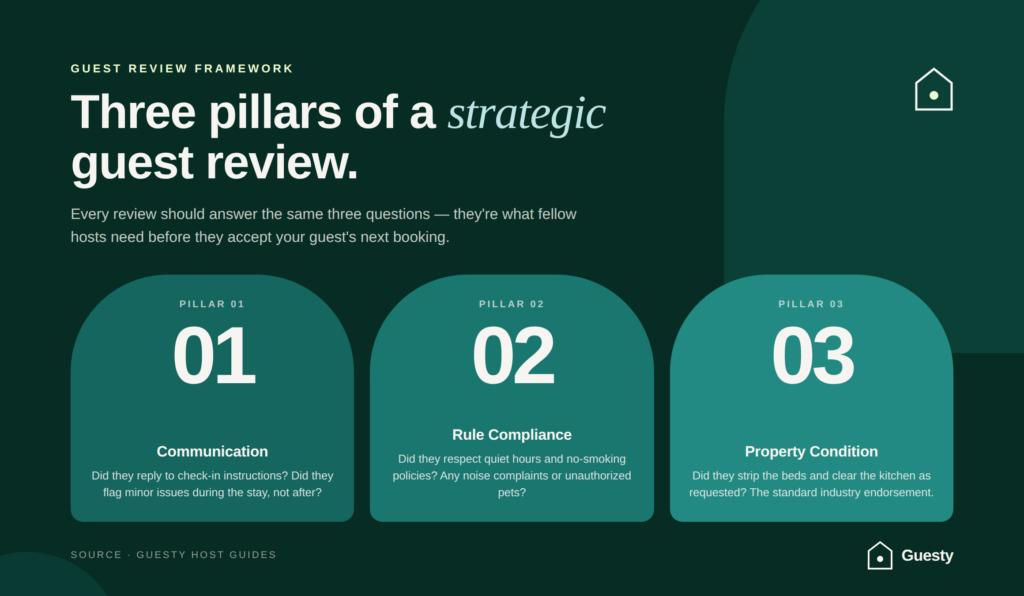
A generic review provides no value to the next host who must decide whether to grant a stranger access to their property. To write a review that adds operational value, focus on three core pillars.
Confirm clear communication
Note if the guest replied to check-in instructions. Mention if they communicated minor issues during the stay, such as a tripped breaker, rather than waiting until checkout to complain. A guest who is easy to reach and follows pre-arrival instructions is a lower risk for future bookings.
Document rule compliance
State whether the guest respected quiet hours and no-smoking policies. This is vital for properties in high-density areas or managed communities where neighbor relations affect your standing. Noise complaints and unauthorized pets are significant risks to your business.
Report property condition
You do not need to expect a professional deep clean from a guest. However, you should note if they stripped the beds or cleared the kitchen as requested. Mentioning that the guest left the home in excellent condition is the primary endorsement in the industry.
Standardize your guest feedback templates
Efficiency is required to scale a hosting business. Use these templates to maintain professional standards without increasing your workload.
The model guest
“It was a pleasure hosting [Guest Name]. They were excellent communicators, followed all house rules, and left the property in pristine condition. I would welcome them back and recommend them to any host.”
The quiet guest
“[Guest Name] was a low-maintenance guest. They respected the space and left everything exactly as found. This was a simple, five-star experience for any host.”
The minor issue guest
Boost your short term rentals today
“[Guest Name] was a polite guest and left the home clean. There was a small misunderstanding regarding [specific rule], but they were responsive once notified. Overall, the stay was positive.”
Comparison: Positive vs. constructive feedback
| Feature | Highlight in a positive review | Mention in a constructive review |
|---|---|---|
| Communication | “Proactive and friendly” | “Responsive once prompted” |
| House rules | “Followed all rules perfectly” | “Mostly respectful, but missed [rule]” |
| Condition | “Pristine/excellent condition” | “Left some extra cleaning for the crew” |
| Recommendation | “Welcome back anytime” | “Recommended with note on [issue]” |
Manage difficult guests and negative feedback
The most significant risk in the review process is retaliation. This occurs when a guest anticipates a poor review due to damages or rule-breaking and leaves a 1-star rating for the host to protect their own profile.
Time your reviews to avoid retaliation
Wait for your cleaning crew to submit a full report and photos before submitting a review. If there is damage, wait until the end of the 14-day window to submit your feedback. This limits the time the guest has to respond with a retaliatory strike. Most platforms do not reveal your review until the other party has submitted theirs or the window has closed.
Respond to negative feedback professionally
A response to a negative review is written for future guests. Stay factual and avoid emotional language. Address the fix directly. If a guest complained about the AC, state that the unit has since been serviced and is fully functional. A calm, professional response makes a complaining guest look unreliable to future bookers.
Scale your reputation with automation
Manual reviewing becomes a bottleneck as you scale to multiple properties. Automation maintains your presence without increasing your daily administrative load.
Use review pools for variety
To keep your profile looking organic, do not use a single template. Guesty’s automated reviews feature allows you to create randomized template pools. The system rotates through several variations. This ensures your profile remains active and personalized without manual typing.
Set review delays to manage risk
Automation requires operational controls. Within Guesty, you can set a delay of two to three days before an auto-review is sent. This provides your cleaning team a window to report hidden damages or rule violations. If a problem is flagged, you can toggle off the auto-review for that guest and handle the situation manually to protect your reputation.
Convert reviews into repeat bookings
A 5-star review is a signal for a future stay. Once a guest is proven reliable, move them toward direct bookings to increase your margins and avoid OTA fees.
Trigger automated follow-up messages
Use Guesty’s automated message workflows to send a thank you email a few days after a positive review is posted. Sending this via email allows you to include a coupon code for their next stay if they book through your direct website. This converts a single booking into recurring revenue.
Scale your review strategy
Guesty Lite™ (1–3 listings) provides essential automation for hosts managing their first review workflows. Guesty Pro™ (4–499 listings) supports growing portfolios with advanced automation, review pools, and direct booking conversion tools. Guesty Enterprise™ (500+) delivers custom workflows and dedicated support for large-scale operations.