If you’re asking what an OTA is, you’re really asking how to get more bookings for your vacation rental. An Online Travel Agency, or OTA, is a digital marketplace that connects your properties with millions of travelers. They are the single most powerful tool for driving occupancy. But using them effectively without creating operational chaos is the real challenge.
This guide breaks down exactly how OTAs work from a property manager’s perspective. You will learn how to get listed, get paid, and manage the risks. More importantly, you will learn how to control multiple OTAs from one place instead of letting them control you.
TL;DR
- An OTA (Online Travel Agency) is a website like Airbnb or Vrbo that lists your property in exchange for a commission on bookings.
- They provide massive visibility to a global audience you could not otherwise reach.
- The main challenge is operational complexity. Managing listings, calendars, and messages across multiple OTAs manually leads to errors.
- Double bookings are the most common and costly error, caused by calendars not syncing in real time.
- Each OTA has its own payment schedule and fee structure, making financial tracking difficult.
- The solution is to use vacation rental management software to centralize control of all your OTA channels.
What does OTA stand for in travel?
OTA stands for Online Travel Agency. It is an e-commerce website that acts as a digital storefront for travel-related services. For your business, an OTA is a distribution channel. It advertises your short-term rental properties to a global audience, processes bookings, and handles payments.
While OTAs sell flights, rental cars, and hotels, this guide focuses only on the platforms that matter for vacation rentals: Airbnb, Vrbo, and Booking.com.
How online travel agencies work
The business model is a simple partnership. You provide the properties, and the OTA provides the marketing, booking infrastructure, and a global audience of travelers. In exchange for bringing you a confirmed booking, the OTA takes a cut.
The commission model explained
OTAs make money by charging a commission fee on every reservation made through their platform. This fee structure varies.
- Host-only fee: The platform charges you a flat percentage (e.g., 15%) of the booking total. The guest sees an all-inclusive price. This is common on Booking.com.
- Split-fee: The platform splits the commission. You pay a small percentage (e.g., 3%), and the guest pays a larger service fee (e.g., 12-15%). This is the standard model on Airbnb and Vrbo.
Tracking these different fee structures across platforms becomes a significant accounting challenge as you grow. A 3% fee on Vrbo and a 15% fee on Booking.com for the same property dramatically changes your net revenue per booking.
The “billboard effect”
Listing on a major OTA acts as a massive digital billboard for your brand. A traveler might discover your property on Airbnb, then search for your property’s name on Google to find your direct booking website. This “billboard effect” can drive commission-free bookings, but it only works if you have a professional, bookable website for them to find.
What are the top OTAs for short-term rentals?
Focus your efforts on the “big three” before exploring niche channels. Each has a slightly different audience and feel.
Airbnb
The market leader in unique stays, from single rooms to luxury villas. Airbnb’s audience often seeks authentic, local experiences and values host interaction. It is an essential channel for nearly every type of short-term rental.
Vrbo
Part of the Expedia Group, Vrbo (Vacation Rentals by Owner) specializes in entire homes. Its core audience is families and groups looking for traditional vacation homes in popular leisure destinations.
Booking.com
A global powerhouse with a massive audience, particularly strong in Europe. Booking.com’s user base is accustomed to an instant, hotel-like booking experience. Properties listed here often benefit from high volume and last-minute reservations.
Expedia
While primarily known for hotels, Expedia is a valuable channel for serviced apartments, aparthotels, and urban rentals that appeal to business travelers and “bleisure” guests.
How do I list my rentals on OTAs?
Getting your first property live is a manual process. You create an account, write compelling descriptions, upload high-quality photos, detail your amenities, and set your nightly rates and availability.
Now, repeat that entire process for every other OTA you want to be on.
Boost your short term rentals today
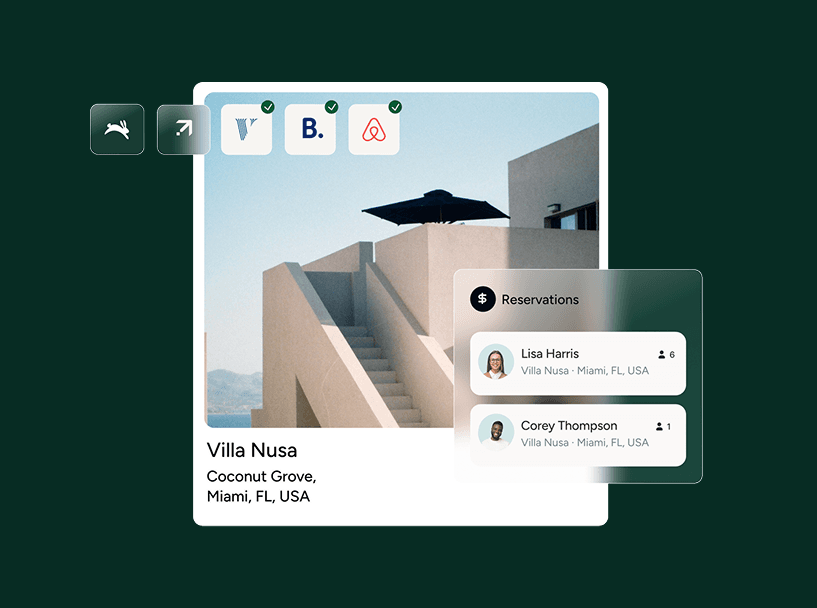
This creates your first major operational problem. Any change to your pricing, photos, or description must be updated manually on each platform. Forget to update one, and you create inconsistencies that confuse guests and hurt your ranking. To manage this efficiently, you need a central system to push updates to all channels simultaneously. A vacation rental channel manager syncs your property information across every OTA, so you only have to update it once.
How does the booking process work?
OTAs offer two ways for guests to book your property. Understanding the difference is critical to avoiding costly mistakes.
- Request to book: A guest sends a booking request. You have 24 hours to review their profile and manually accept or decline. This gives you more control but can feel slow to guests accustomed to instant confirmation.
- Instant book: A guest who meets your requirements can book your property immediately, without needing your approval. The dates are automatically blocked.
Instant book is preferred by guests and favored by OTA algorithms, leading to higher visibility and more bookings. But it introduces a huge risk. If a guest instant-books your property on Airbnb for a weekend that was already booked on Vrbo, you have a double booking. You must now cancel on one guest, damaging your reputation, hurting your search ranking, and potentially incurring financial penalties.
A guest arrives for their holiday weekend to find another family already checked in. Your phone rings. The rest of your night is spent on damage control.
The only way to safely use instant book across multiple channels is with a single, synchronized calendar that updates across all OTAs in real time. When a booking happens on one channel, the dates are instantly blocked on all others. This is a core function of a tool like the Guesty® Multi-Calendar™.
How do I get paid for bookings made through OTAs?
Each OTA is its own bank. They process the guest’s payment, hold the funds, and release your payout according to their own schedule.
- Airbnb typically sends your payout about 24 hours after the guest’s scheduled check-in time.
- Vrbo sends the payout one business day after check-in, but it can take 5-7 business days to appear in your account.
- Booking.com offers various payout models, often processing payments monthly.
This fragmentation creates a cash flow management nightmare. You have money coming from different sources on different schedules, each with different commission fees deducted. Reconciling this manually is time-consuming and prone to error. Centralize your financial data by using a payment processor built for the industry. A system like GuestyPay™ unifies your transaction data, helping you track revenue and manage cash flow from all your booking sources in one place.
How do I get reviews on OTAs?
Guest reviews are the currency of trust on OTAs. More high-quality reviews lead to better visibility in search results, higher conversion rates, and the ability to command higher nightly rates.
After a guest checks out, OTAs automatically send a prompt asking them to leave a review. Your job is to earn that 5-star review by providing a flawless experience from booking to departure. This includes clear communication, a spotless property, and a simple check-in process. A high review score is not a vanity metric. It is a direct driver of revenue.
Pros and cons of using OTAs for your rental business
| Pros | Cons |
|---|---|
| Massive global exposure | Commission fees reduce your margin |
| Built-in trust and secure payments | Less control over cancellation policies |
| Reduced marketing workload | You do not own the guest relationship |
| Fill occupancy gaps in your calendar | High competition with other listings |
Manage multiple OTAs without the headaches
The benefits of OTAs are clear, but the operational problems grow with every property and every channel you add. The manual work of managing listings, avoiding double bookings, answering messages, and tracking payments becomes unsustainable.
The solution is to manage them from a single, centralized platform. Vacation rental management software acts as your command center.
- Listings: Update property details once and sync them everywhere with a channel manager.
- Bookings: View all reservations from all channels on one master calendar to eliminate double bookings.
- Communication: Manage all guest messages from Airbnb, Vrbo, and your email in a Unified Inbox.
- Payments: Track all your revenue and payouts in one financial dashboard.