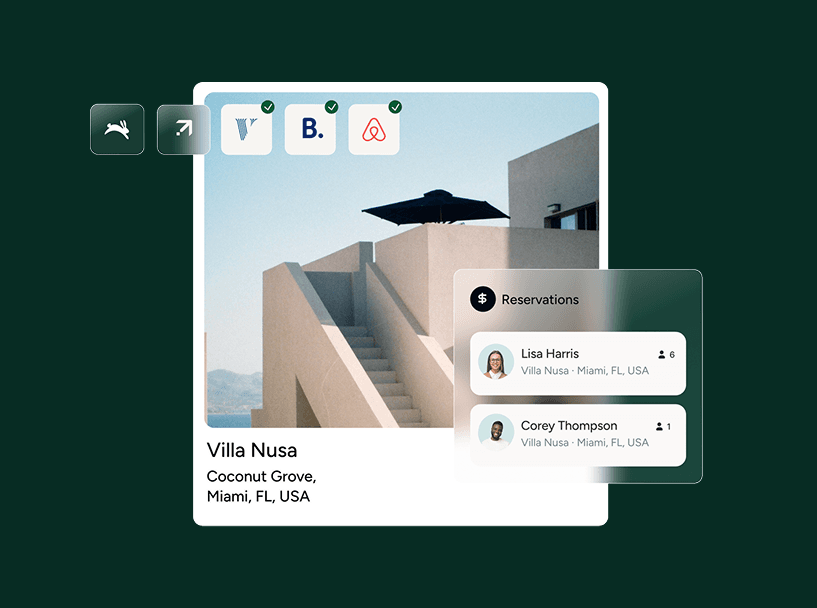
If you’re searching “channel manager vs. PMS,” you’re asking a question from five years ago. You’re trying to solve today’s scaling problems with yesterday’s tools. The focus should be on getting both distribution and operations to work together from a single command center.
Running them as separate systems creates data gaps, manual work, and a ceiling on your growth. For a modern short-term rental business, the “vs.” debate is over. You need one platform that acts as the engine for your entire business, from the first click on an OTA to the final owner payout.
TL;DR
- A channel manager is your distribution engine. It lists your properties on multiple online travel agencies (OTAs) and syncs your rates and availability to prevent double bookings.
- A property management system (PMS) is your operations engine. It handles everything after a booking is confirmed: guest communication, cleaning schedules, payments, and owner reporting.
- Running them separately creates inefficiency. You risk data silos, missed messages, and operational errors that lead to bad reviews.
- The modern solution is a unified platform where the channel manager and PMS are integrated.
- The next evolution is the agentic AI platform, which executes operational work to break the link between portfolio growth and team workload.
The core difference: selling your inventory vs. running your business
Think of it this way. A channel manager is your digital storefront. It places your properties on every important shelf, like Airbnb, Vrbo, and Booking.com. Its job is to increase visibility and make sure the price tag is always correct.
A property management system (PMS) is your central operations hub. It’s the brain and the backbone of your business. When a booking comes in, the PMS takes over to ensure every step from payment to check-out is executed correctly. One engine sells. The other fulfills. You need both to grow.
What is a channel manager?
A channel manager is software that connects your properties to multiple online booking channels from one central dashboard. Instead of manually updating your calendar and rates on Airbnb, then Vrbo, then Booking.com, you do it once. The channel manager pushes those updates everywhere automatically.
Its primary job is to protect your revenue and reputation by eliminating double bookings. An operator with a solid channel manager strategy spends less time on administrative updates and more time optimizing their distribution.
Real-time rate and availability syncing
The core function is synchronization. When a guest books a week in July on Airbnb, the channel manager instantly blocks those dates on Vrbo, Booking.com, and your direct booking site. This happens in seconds through an API connection, which is a direct, reliable data feed between systems. Free iCal connections are often too slow for professional operators, leading to synchronization lags that cause costly double bookings.
Centralized listing management
A channel manager also allows you to update property details like photos, descriptions, and amenities from one place. Change a photo or add a new amenity, and the update populates across every channel you’re listed on. This ensures brand consistency and saves dozens of hours of manual work.
Multi-channel distribution strategy
A powerful vacation rental channel manager also enables a sophisticated distribution strategy. It allows you to set channel-specific pricing, so you can add a markup on one channel to cover its higher commission fee or run a promotion on another to capture more bookings during a slow period. This is how you build a distribution strategy that increases revenue from each channel.
What is a property management system (PMS)?
A property management system (PMS) is the command center for your internal operations. If the channel manager handles getting the booking, the PMS handles everything that happens next. It’s where you manage the entire guest journey, coordinate your team, and track your financial performance.
A basic PMS automates tasks. A modern PMS automates work. It uses AI agents to execute day-to-day operations across your business, from guest communication to financial reconciliation. This allows you to scale your portfolio without scaling your headcount at the same rate.
Centralized reservations and guest communication
All reservations, regardless of their source, appear in a single calendar. Every guest message from every platform flows into a unified inbox. This eliminates the need to constantly switch between apps and browser tabs. You can respond faster, assign conversations to team members, and use automated messages for routine questions.
Boost your short term rentals today
Automated workflows for tasks and turnovers
When a guest checks out, a workflow is automatically triggered. The cleaning team is notified, a task is created with a checklist, and the property is marked as “dirty” in your calendar. When the cleaning is complete, the property is marked “clean” and ready for the next guest. These automated workflows ensure nothing is missed, standardize your quality of service, and make same-day turnovers manageable.
Payment processing and financial reporting
A PMS integrates payment processing, allowing you to securely collect payments, issue refunds, and manage security deposits. It tracks every transaction associated with a booking, from the nightly rate to cleaning fees and taxes. This data then flows into financial reports, giving you a clear view of your revenue, expenses, and profitability.
Owner management and reporting
For property managers who work with homeowners, a PMS centralizes communication and builds trust. An owner portal gives homeowners a dedicated login to view their property’s performance, see upcoming bookings, block dates for personal stays, and access monthly financial statements. This transparency reduces back-and-forth emails and strengthens your relationship with your most important partners.
Channel manager vs. PMS at a glance
| Feature | Channel Manager | Property Management System (PMS) |
|---|---|---|
| Primary Goal | Maximize distribution and prevent double bookings | Streamline operations and improve the guest experience |
| Core Tasks | Syncing rates and availability, updating listings | Guest communication, task management, payment processing |
| Main Benefit | Increased revenue and time savings | Increased efficiency and service consistency |
| Who Uses It | Revenue or marketing manager | Operations manager, guest services team, owner |
| Key Metric | Occupancy rate, revenue per available night (RevPAN) | Guest satisfaction score, task completion time |
See how they work together: the complete guest journey
In an all-in-one platform, you don’t see a “channel manager” and a “PMS.” You just see a smooth, automated workflow. Here’s how it looks in practice.
1. A guest books: A traveler books a three-night stay on Booking.com. The channel manager function instantly receives the reservation and blocks the dates on Airbnb, Vrbo, and your direct booking site.
2. Confirmation is sent: The PMS function takes over. It automatically sends a personalized confirmation email to the guest and schedules future messages, like pre-arrival instructions.
3. Payment is processed: The integrated payment processor securely charges the guest’s card according to your payment schedule.
4. Turnover is scheduled: The PMS automatically creates a cleaning task and assigns it to the designated cleaner, scheduled for the morning of check-out. A maintenance task to check the HVAC filter is also scheduled.
5. Guest checks out: After the guest leaves, the PMS automatically triggers a review request message.
6. Reporting is generated: The revenue from the booking is included in your monthly performance reports and automatically calculated in the property owner’s statement. This entire process happens without you manually intervening at any step, powered by your platform’s ability to create custom reporting and analytics.
Why a separate channel manager is holding you back
The “vs.” debate is dangerous because it implies you can choose one or that running two separate systems is a viable strategy for growth. It isn’t. An operator trying to scale with a standalone channel manager and a separate PMS will eventually hit a wall. Data gets lost. Workflows break. You spend your time trying to get two systems to talk to each other instead of focusing on growing your business.
A modern, all-in-one vacation rental management software is the only way to scale efficiently. The platform’s real advantage is how its features share data and context to create a smarter, more automated operation. When your distribution engine and your operations engine are part of the same chassis, your business runs faster and leaner. This is why Guesty® built a single platform designed to scale with you. Guesty® Lite™ provides hosts with 1-3 properties the essential tools to sync channels and automate messaging. Guesty® Pro™ gives growing operators with 4-499 listings the advanced operational controls, reporting, and automation needed to build a professional brand. Guesty Enterprise™ offers large-scale hospitality operators with 500+ properties the customizable workflows, open API, and enterprise-grade security to manage complex portfolios.