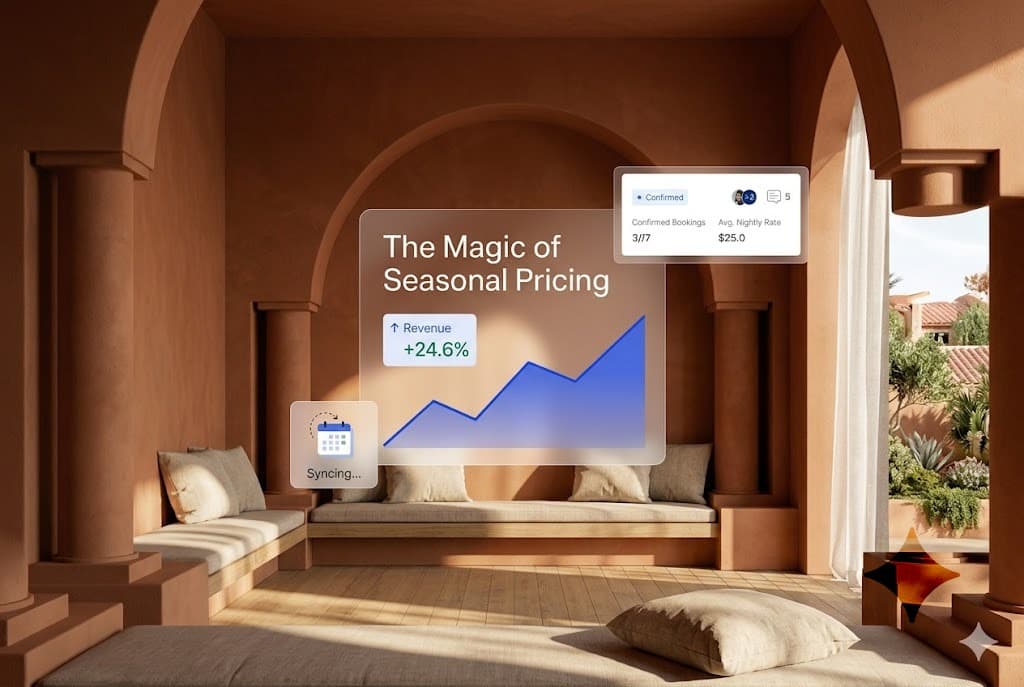
Keeping the same nightly rate in October that you charged in July ignores supply and demand entirely, you overprice in slow months and underprice in peak ones, losing revenue in both directions.
Many vacation rentals in the United States sit vacant for a significant portion of the year, with occupancy rates varying widely by market and season. This means many properties are vacant for nearly six months. Seasonal pricing bridges this gap, ensuring rates reflect guest willingness to pay while protecting the bottom line when demand drops.
TL;DR
- Static pricing causes missed revenue during peaks and high vacancy during troughs.
- Peak season requires aggressive Average Daily Rate (ADR) increases and minimum stay requirements.
- Low season demands a shift toward occupancy and mid-term stays for digital nomads.
- Shoulder seasons offer a mid-week opportunity for local travelers.
- Automation through dynamic pricing tools outperforms manual updates by reacting to real-time micro-trends.
- Track RevPAR and booking lead times to measure strategy success.
What is seasonal pricing in vacation rentals?
Seasonal pricing is the practice of adjusting nightly rates based on predictable fluctuations in travel demand. You increase prices when travelers flood a market and lower them when the crowds thin.
Ignoring these cycles creates two major risks. Underpricing during high demand allows guests to book a home at a bargain, while overpricing during low demand leads to zero bookings. Effective seasonal pricing balances ADR with occupancy to increase total revenue.
Market travel seasons
Travel patterns vary by location, but most US markets follow a three-tier structure. Understanding these shifts allows you to adjust operational focus before the season changes.
Peak season: High demand and premium rates
Demand exceeds supply during summer holidays, winter ski seasons, or major local festivals. Guests book months in advance and are less price-sensitive. Operations should focus on increasing margins during these windows.
Low season: High vacancy and value-driven guests
Travelers are scarce because weather is unfavorable or school schedules limit family trips. Guests who do travel look for deals. The operational priority shifts to covering fixed costs like mortgages and utilities.
Shoulder season: The bridge between extremes
These weeks sit between peak and low seasons when demand is moderate. Interest is high enough to keep the property occupied, but not enough to charge peak premiums. This is the time to target specific niches, such as retirees or remote workers.
High-season margin strategies
During peak demand, the goal is yield management. You want to extract the highest possible value from every available night. If a property is 100% booked three months in advance, the prices are likely too low.
Minimum night stay requirements
Short stays during peak season create calendar gaps that are difficult to fill. Setting a three-night or four-night minimum for high-demand windows reduces turnover costs and protects cleaning staff from burnout during the busiest weeks.
Peak-season holiday premiums
Holidays like the Fourth of July or Labor Day require specific manual overrides. Use Guesty® PriceOptimizer™ to automate these surges based on real-time market demand and competitor activity. This ensures you capture localized spikes in interest.
A guest attempts to book a premium beachfront villa for a major holiday weekend. The nightly rate is 40% higher than the previous week. The guest completes the booking anyway because no comparable inventory remains in the area.
Low-season occupancy and protection
Low season focuses on survival and volume. High ADR has no value if occupancy is zero. Shift marketing and pricing to attract guest personas who are less tied to traditional holiday schedules.
Mid-term stays for digital nomads and corporate travelers
Lowering nightly rates for stays of 28 days or longer attracts digital nomads who seek out off-season locations for lower costs. These guests provide guaranteed income with less wear and tear than short-term vacationers.
Boost your short term rentals today
Margin protection with Guesty Shield™
Lowering prices can sometimes attract guests who treat properties with less care. Instead of charging high security deposits that deter bookings, use Guesty Shield™ to provide damage protection. This removes booking friction for the guest while ensuring the operator is not stuck with repair bills.
A guest searches for a budget-friendly winter stay in a mountain town and sees two identical properties. One requires a $1,000 security deposit, while the other uses a small protection fee. The guest chooses the second option immediately.
How to capture the shoulder season mid-week gap
The shoulder season offers a mid-week revenue opportunity. While weekends may still attract local getaway travelers, Tuesdays and Wednesdays often sit empty.
Target local travelers within a three-hour driving radius by offering a “Stay 3, Pay 2” promotion for mid-week stays. This fills gaps that would otherwise generate zero revenue. It also keeps preferred cleaning vendors busy during their slow periods, ensuring they remain available when peak season returns.
Manual vs. dynamic pricing
Manual pricing works for a single listing with a highly predictable market. As you scale, the labor required to track every local concert, school break, and competitor price drop becomes unsustainable.
| Feature | Manual Pricing | Dynamic Pricing | Operational Impact |
|---|---|---|---|
| Reaction Time | Delayed (weekly/monthly) | Real-time (multiple times per day) | Dynamic pricing captures sudden demand spikes. |
| Data Source | Owner intuition | Hyper-local market data and APIs | Automation removes guesswork from pricing. |
| Effort | High labor hours | Set-and-forget with overrides | Operators save hours per listing each week. |
| Accuracy | Misses micro-trends | Detects demand instantly | Prevents underpricing during local events. |
| Revenue Impact | High risk of vacancy | Typically increases RevPAR significantly | Increases total annual yield. |
Dynamic pricing manages your rates automatically and protects your management time.
Four metrics every revenue manager must track
You cannot manage what you do not measure. Use these four metrics to audit seasonal performance.
- Average Daily Rate (ADR): The average income earned per paid occupied room.
- Revenue Per Available Rental (RevPAR): Total revenue divided by the total number of available nights.
- Occupancy Rate vs. Market Average: If occupancy is significantly higher than the market average, the property is likely underpriced.
- Booking Window Lead Time: How far in advance guests book; if this window shrinks, demand is dropping.
Common seasonal pricing mistakes to avoid
One common mistake is overpricing in the peak season. Waiting for a high-value guest who never arrives can leave a five-night gap empty. Another mistake is extreme discounting in the low season. Dropping rates by a massive percentage often attracts guests who cause more damage than the booking revenue covers.
If a strategy feels ineffective, Guesty Revenue Management Consulting provides a professional audit to identify missed revenue opportunities specific to portfolio size and location. Dynamic pricing increases revenue, though niche properties with irregular demand often require manual oversight to ensure accuracy.
Scaling a vacation rental business requires tools that grow with the portfolio. Guesty Lite™ (1–3 listings) provides the core automation tools for basic seasonal adjustments. Guesty Pro™ (4–499 listings) offers advanced reporting and API integrations for growing portfolios. Guesty Enterprise™ (500+ listings) provides custom infrastructure and specialized tools for large-scale operations. Guesty also offers human-staffed support services for guest communication and revenue management tasks.