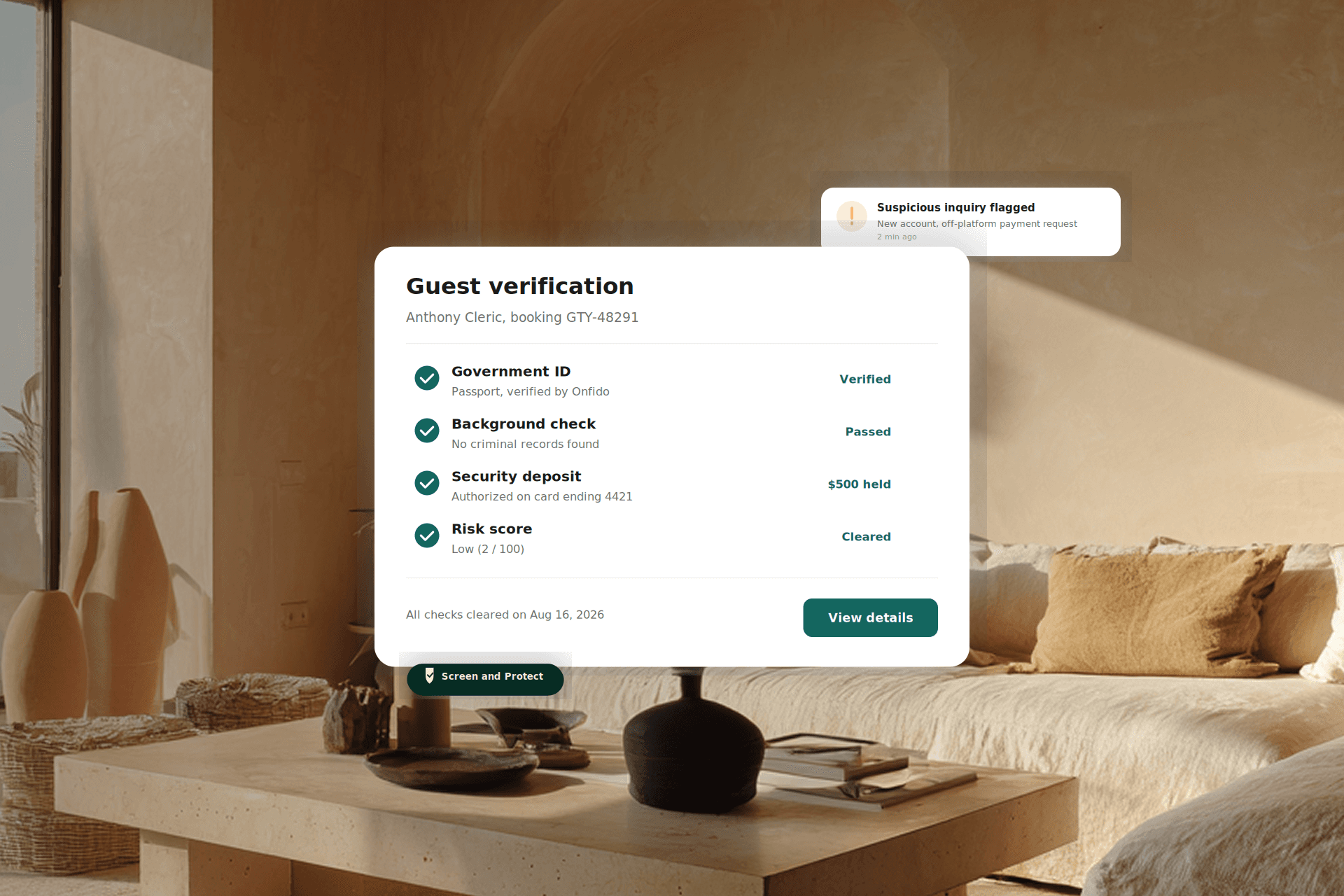
Managing a growing portfolio of short-term rentals means managing increasing complexity. While the vast majority of guests are wonderful, the financial and reputational risk from a single scammer multiplies as you scale. Relying on intuition to spot a bad actor simply doesn’t work when you have dozens or hundreds of check-ins a month. Protecting your revenue, properties, and your brand requires a scalable, tech-enabled system.
This guide moves beyond one-off tips for individual hosts. We’ll break down the most common guest scams and provide systematic, operational strategies for professional operators to prevent them before they happen.
TL;DR
- As your portfolio grows, manual trust and safety checks become a bottleneck and a liability.
- The most common scams target damage deposits, credit card payments, and platform policies.
- Proactive prevention is more effective than reactive resolution. Focus on systems, not just instincts.
- Document everything. Pre-stay photos, on-platform communication, and clear house rules are your best defense.
- Use technology to automate security. Smart locks, secure payment processors, and centralized inboxes create a stronger operational defense.
- Avoid off-platform communication and payments at all costs. It voids platform protections and creates an unauditable mess.
The growing operator’s challenge: Scaling trust and safety
When you manage one or two properties, you can personally vet every guest interaction. You remember the booking details, you handle the messages, and you inspect the property yourself. At ten, fifty, or one hundred properties, that hands-on approach breaks down.
As the number of potential issues increases, your systems for communication, payment, and operations become fragmented. Information gets lost between team members. A red flag spotted by your booking agent might not get passed to the on-site manager. This is where scammers find their opening.
Building a proactive defense system means standardizing your processes and using technology to create a safety net. This creates repeatable workflows that protect your business automatically, allowing your team to focus on delivering great guest experiences instead of playing detective.
7 common Airbnb guest scams and how to stop them
Understanding the playbook is the first step to countering it. Here are the most prevalent scams targeting property managers and the systems you can build to shut them down.
1. The “it was already broken” scam
A guest damages a piece of furniture, a kitchen appliance, or a wall. When you file a claim against their security deposit, they dispute it, insisting the damage was pre-existing. Without ironclad proof, it becomes their word against yours, and booking platforms often side with the guest to avoid conflict.
Red flags:
- Guest reports multiple “pre-existing” issues immediately upon arrival, often in a vague way.
- Refusal to communicate about the damage through the official platform channel.
- The damage is conveniently located in a spot you might miss during a quick turnover inspection.
Prevention:
Your defense here is documentation. Create a non-negotiable, pre-stay workflow for your operations team. This includes taking time-stamped photos and videos of the entire property, especially high-value items, before every single check-in. Store these assets in a central folder tied to the reservation.
Even better, move away from security deposits altogether. They create friction with honest guests and are a frequent target for scammers. Using a dedicated Guesty Damage Protection program provides coverage without requiring a deposit, streamlining the claims process with professional handling and removing the guest from the middle of the resolution.
2. The “friendly fraud” scam
This one stings. The guest has a seemingly perfect stay, leaves a glowing review, and then, weeks later, you get a notification from your bank. The guest has initiated a chargeback, claiming the transaction was fraudulent or the service wasn’t as described. You’re now out the entire reservation revenue plus a painful chargeback fee.
Fighting chargebacks is a time-consuming, document-heavy process you rarely win. For a growing business, the operational drain is often worse than the financial loss itself.
Red flags:
- Guest uses a credit card with a name that doesn’t match their profile.
- A last-minute booking for a long, expensive stay, especially from a new profile.
- Odd or evasive communication prior to booking.
Prevention:
Your first line of defense is your payment processor. Standard processors aren’t built for the unique risks of hospitality. You need a system with fraud detection trained on travel industry data. A solution like GuestyPay uses AI algorithms to analyze transactions in real-time, flagging high-risk indicators specific to short-term rentals and blocking fraudulent payments before they ever process.
3. The “let’s talk offline” scam
A guest asks to communicate via WhatsApp or pay you directly through Venmo, often with a story about saving on fees or the platform’s messaging being “clunky.” Once you move the conversation or payment off-platform, you lose all of Airbnb’s protections. The guest can cancel the payment, fabricate claims about the stay, or simply disappear without a trace.
Red flags:
- Any request to communicate or transact outside the booking platform.
- An offer that seems too good to be true, like paying a premium for a direct deal.
- Urgency or pressure to make a decision quickly.
Prevention:
This is a simple, bright-line rule for your entire team: all communication and payments stay on the platform. Period. To make this scalable, use a Unified Inbox that consolidates all guest messages from every channel, including Airbnb, Vrbo, and your direct booking site. This creates a single, auditable record of every conversation, which is your primary evidence in any dispute. It also makes it easy for your team to manage communication without feeling the need to switch to personal apps.
4. The “surprise party” scam
Boost your short term rentals today
A guest books your property for two people for a quiet weekend. On Saturday night, your neighbors call to complain about a party with 50 people, loud music, and cars blocking the street. By the time you intervene, the damage is done. The property is thrashed, your relationship with your neighbors is strained, and you risk being delisted by the city or the platform.
Red flags:
- A local guest booking for a one-night stay on a weekend.
- A new profile with no reviews.
- Vague answers when asked about the purpose of their trip.
Prevention:
First, clearly state your “no parties” rule in your house rules, listing description, and pre-stay automated messages. Second, implement basic guest screening. Third, use technology. Smart locks give you control over who has access and when. A tool like Guesty Locks Manager can generate a unique code for each guest that activates at check-in and expires at check-out, preventing early entry or late stays. For added security, install disclosed noise monitoring devices and exterior cameras.
5. The phishing scam
You receive an urgent message that appears to be from Airbnb Support. It claims there’s a problem with your payout, and you need to click a link to verify your account details immediately. The link leads to a fake login page that captures your credentials, giving the scammer full access to your account, financial information, and upcoming reservations.
Red flags:
- A sense of extreme urgency or threats (e.g., “your account will be suspended”).
- Spelling and grammar mistakes in the message.
- A link that directs you to a URL that isn’t the official Airbnb.com domain.
Prevention:
Train your team to be skeptical. Airbnb will never ask for your password or financial information over email or its messaging service. Always log in to your account directly through the official website or app to check for notifications. If a message seems suspicious, report it. Never click links in unsolicited emails.
6. The “extra guest” scam
The reservation is for two guests, but you review your exterior camera footage and see four people coming and going. The extra guests increase wear and tear, utility usage, and potential liability, all of which comes directly out of your margin.
Red flags:
- The guest is hesitant to provide the names of everyone in their party.
- Photos on their profile show them with a larger group of friends.
- The inquiry mentions an event or gathering that seems too large for the stated number of guests.
Prevention:
Be explicit in your listing about your maximum occupancy and your policy on visitors. If you charge for extra guests, make that clear in the pricing structure. Disclose the use of any exterior security cameras in your listing description, which often deters guests from trying to sneak in extra people.
7. The “squatter” scam
This is the rarest but most severe scam. A guest books a stay, often for 28 days or longer, and then refuses to leave at the end of the reservation. They exploit local landlord-tenant laws, which in some jurisdictions can grant them tenant rights after a certain period. Removing them can require a formal, lengthy, and expensive eviction process.
Red flags:
- A guest asking to book for just over the legal threshold for tenancy in your area (often 30 days).
- Requests to receive mail at the property.
- Questions about eviction laws in your city.
Prevention:
Know your local laws. Understand the difference between a short-term rental guest and a long-term tenant in your jurisdiction. Many operators set a maximum stay length of 28 or 29 days to avoid this issue entirely. For any stay longer than that, insist on a formal lease agreement that clearly defines the terms and waives tenancy rights.
At-a-glance scam prevention plan
| Scam Type | Key Red Flag | Best Prevention Tool |
|---|---|---|
| Fake Damage Claim | Vague reports of “pre-existing” issues | Time-stamped, pre-stay photo/video documentation |
| Chargeback Fraud | Last-minute booking with mismatched card name | A payment processor with hospitality-focused fraud detection |
| Off-Platform Activity | Any request to pay or talk outside the app | A unified inbox to centralize all communication |
| Unauthorized Party | Local, one-night weekend booking | Smart locks and disclosed noise monitoring devices |
| Phishing Attack | Urgent message with a suspicious link | Team training and direct login to the official site |
| Extra Guests | Hesitation to confirm the number of people | Clearly stated occupancy limits and disclosed exterior cameras |
| Squatting | Request for a stay just over the 30-day mark | Maximum stay limits and formal lease agreements for long stays |
Building your proactive defense system
A proactive defense system is built on four pillars:
1. Automated guest screening: Use tools to verify guest identity and cross-reference them against watchlists.
2. Centralized communication: Ensure every guest interaction is logged in a single, auditable system.
3. Secure payment processing: Implement a payment gateway designed to detect and block the specific fraud patterns of the travel industry.
4. Smart home technology: Use smart locks, noise monitors, and cameras to maintain control and visibility over your properties.
As your business grows, the complexity of this system evolves. For hosts managing 1–3 properties, a platform like Guesty® Lite™ provides the essential tools for centralizing bookings and communication. As you scale to a larger portfolio, the deeper capabilities of Guesty® Pro™ become critical for managing teams, automating complex workflows with Automation Tools, and integrating a full suite of trust and safety technologies. For large-scale operators, Guesty® Enterprise™ provides the robust, customizable infrastructure needed to manage risk across hundreds or thousands of properties. Match your defense system to the scale of your risk.