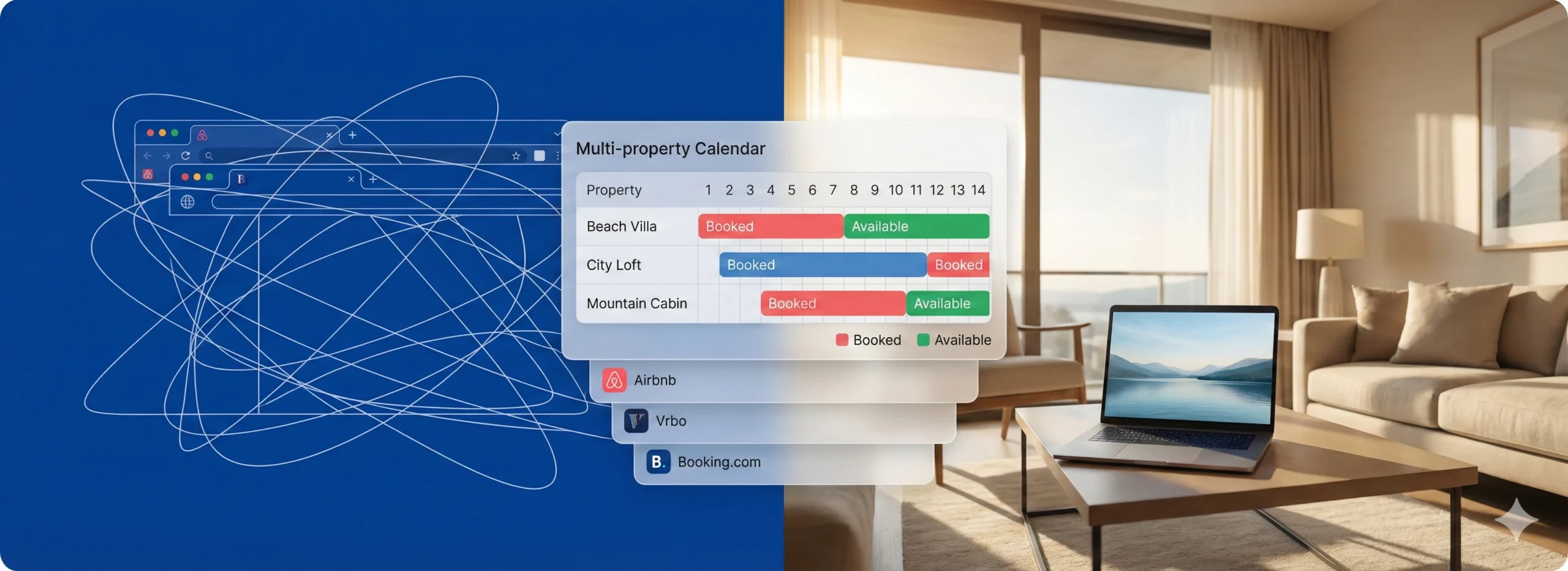
Short-term rental operators must constantly balance where their reservations originate. Online travel agencies like Airbnb and Vrbo provide broad market reach and handle initial guest acquisition, but commissions eat into margins and distance you from your guests. Direct bookings through your own website eliminate those fees and give you full control over the guest relationship — but insufficient OTA presence limits your reach and can leave gaps in occupancy.
Sustainable revenue depends on an intentional approach to channel management rather than a passive “set it and forget it” mindset. Heavy OTA reliance reduces net revenue, while an underdeveloped direct booking strategy leaves money on the table. The goal is balancing both channels to meet your specific property goals and target margins.
TL;DR
- Direct bookings increase net revenue by eliminating third-party commission fees.
- OTAs provide large-scale reach and a built-in audience that is difficult to replicate independently.
- Direct bookings allow full ownership of guest relationships and data for re-marketing.
- Effective channel management balances both to maintain occupancy and revenue targets.
- A strong direct booking presence requires investment in a functional website and active marketing.
- OTAs are useful for filling occupancy gaps and reaching new market segments.
- Short-term rental management software centralizes calendars and automates mixed-channel strategies.
Understand the core differences in booking channels
Channel management defines the entire guest transaction and data ownership model. It involves more than the point of reservation; it dictates your control over the business.
What defines a direct booking?
A direct booking occurs when a guest reserves a property through your brand’s own assets, such as your website, a phone inquiry, or a direct email. In this model, you own the entire transaction. No third-party platform dictates the terms, fees, or communication protocols. You set the pricing, manage the payment processing, and collect guest data directly. This data ownership facilitates direct re-marketing and repeat business.
How online travel agencies work
OTAs act as centralized marketplaces that aggregate listings to reach a global audience. When a guest reserves through an OTA, the platform manages the transaction, including payment processing and initial communication. In exchange for this infrastructure and reach, the platform charges a commission. This cost covers the platform’s marketing spend and provides a level of guest confidence that smaller independent brands may lack.
What are the benefits of direct bookings?
Increasing direct bookings protects your margins and reduces platform dependency. This approach provides the operational and financial control necessary to protect your business from sudden platform policy changes.
Control your guest relationships
Direct bookings place the guest relationship entirely in your hands. You control the communication flow, including pre-arrival guides and post-stay follow-ups. This allows for personalized messaging and tailored upsell opportunities. Direct communication helps resolve issues quickly and encourages repeat stays. This loyalty builds a resilient brand that does not rely solely on external algorithms.
Improve your profit margins
OTA commissions typically range from 3% to 25%, representing a significant portion of gross revenue. Direct bookings keep these fees within your business. Retaining this percentage increases your net income on every reservation. Over time, shifting even a small portion of your booking volume to direct channels significantly improves your annual profitability.
Own your data and marketing
Direct bookings provide access to essential guest data, including email addresses, preferences, and stay history. This information is essential for targeted re-marketing. You can build email campaigns, offer loyalty discounts, and analyze guest demographics without third-party restrictions. Owning this data allows you to react to market shifts and build a customer acquisition process that you control.
Why do property managers rely on OTAs?
OTAs remain a necessary component of a diversified booking strategy. They provide essential reach, particularly for new listings or during low-occupancy periods.
Instant exposure to a global audience
OTAs are large-scale distribution platforms that spend heavily on advertising and search engine optimization. Listing on these platforms provides immediate access to a global audience that would be expensive to reach independently. This scale allows international travelers to find your property without a dedicated international marketing budget.
Simplified booking and payment infrastructure
OTAs remove the administrative burden of building a custom booking engine or integrating payment gateways. Their platforms provide a functional guest experience designed for high conversion rates. For operators managing multiple properties, this ready-made infrastructure saves significant time and technical resources.
Built-in trust and credibility
Guests often rely on established platform protections, such as verified review systems and secure dispute resolution. For newer properties or local brands, this established credibility reduces the perceived risk for the guest. This trust factor can lead to higher initial booking rates while you build your independent brand reputation.
Boost your short term rentals today
| Management function | Direct booking approach | OTA approach |
|---|---|---|
| Pricing control | You set final prices and discounts | OTA commission impacts net revenue; dynamic pricing depends on their tools |
| Guest communication | Direct and personalized; builds long-term relationships | Mediated by platform; limited customization |
| Guest data ownership | Full ownership for re-marketing and loyalty programs | Limited access to contact info and stay history |
| Booking flexibility | You define cancellation policies and terms | Options limited to platform-approved policy tiers |
| Marketing spend | Investment in SEO, website, and paid ads | Commission fees are the primary cost per booking |
| Brand building | Strengthens independent brand identity | Property is one of many; brand is secondary to the platform |
Building a direct booking strategy
Long-term profitability requires a proactive direct booking strategy. This is not a passive revenue stream; it requires active management and investment.
Create a professional direct booking website
Your website is your primary sales tool. It must be mobile-responsive, fast, and easy to navigate. High-quality photography and detailed property descriptions are required. The site must include an integrated professional direct booking website that displays real-time availability and processes payments securely. A poorly functioning website reflects negatively on your professional standards.
Implement clear pricing and availability
Transparency is essential for direct guests. Display your best rates and clearly state all inclusions. Consider incentivizing direct bookings with perks such as flexible check-in times or a small discount. Guests should feel they are receiving a better value or a more flexible experience by booking directly with you.
Drive traffic to your site
Traffic acquisition requires a combination of search engine optimization (SEO) focused on local keywords and targeted paid advertising on search engines or social media. Active engagement on social platforms can showcase property features and local experiences to a wider audience. Email marketing is also a primary tool for nurturing past guests and offering incentives for future direct stays.
Managing your OTA listings effectively
Using OTAs requires a tactical approach to ensure the platforms work in your favor.
Improve listing performance for reach
Platforms prioritize listings that are active and well-maintained. Use professional photography and write descriptions that emphasize unique property features. Respond to all inquiries quickly and keep your calendar updated. The more active your listing is, the more reach the platform will provide.
Maintain review scores
Reviews are the primary currency on OTAs. High scores lead to better search placement and higher conversion rates. Actively encourage guests to leave feedback and provide professional responses to every review. Future guests evaluate your professionalism based on your replies to complaints, which can influence their decision to book.
Use channel management to avoid double bookings
Managing multiple OTAs alongside a direct site manually leads to scheduling errors. A double booking damages your reputation and causes unnecessary operational stress. Use short-term rental management software with channel management capabilities to centralize your calendar. This ensures availability is updated across all platforms instantly, allowing you to focus on revenue strategy.
Integrating your booking channels
Effective operations require all channels to function as a unified system rather than isolated silos.
Centralize your calendar and reservations
A single source of truth for availability is mandatory. Your management software should aggregate all reservations into a master calendar regardless of the source. This prevents overbookings and provides an accurate view of your occupancy and revenue performance.
Standardize guest communication
Consistent communication reduces support tickets. Set up automated messaging for check-in instructions and stay-related information across all channels. While direct bookings allow for deeper personalization, standardizing key touchpoints ensures all guests receive necessary information on time.
Operational friction often occurs when direct booking systems are not fully integrated with access management or property management software. For example, if a guest receives an outdated smart lock code because the direct booking didn’t sync with the hardware provider, the stay begins with a service failure.
Direct booking channels require consistent marketing and updates to compete with established platforms. For seasonal properties, direct efforts may require more effort for the return compared to using OTAs for baseline occupancy. Scaling your direct booking infrastructure requires management software that supports different portfolio sizes, providing core automation for small hosts and advanced onboarding and reporting for enterprise operators.