If you’re asking what a property manager costs, you’re already one step ahead of most hosts. The fee is only one part of the equation. The other is what you give up for that price. Handing over 15-30% of your revenue also means handing over control of the guest experience, pricing strategy, and your brand. For some, it’s a necessary trade-off. For others, it’s an expensive shortcut that costs more than it saves.
Before you sign a contract, you need to understand the fee structures, the hidden costs, and the powerful middle ground between paying a manager and doing everything yourself. This guide breaks down exactly what you’re paying for and how to decide if it’s the right move for your business.
TL;DR
- Full-service Airbnb property management fees typically range from 15% to 30% of your booking revenue.
- The three main fee structures are percentage-based, flat monthly fees, and a hybrid of both.
- Your final fee depends on your property’s location, size, and the specific scope of services you need.
- Watch for additional costs not included in the base commission, like onboarding fees, maintenance markups, and supply restocking charges.
- Partial management (a co-host) costs less (10-20%) but leaves major operational tasks on your plate.
- The alternative to a manager is using software to automate the work yourself and keep the entire commission.
- A vacation rental software like Guesty® lets you manage like a pro but keep the 20% commission for yourself.
What’s the average fee for an Airbnb property manager?
The direct answer: expect to pay between 15% and 30% of your monthly booking revenue for full-service Airbnb property management. For a property earning $4,000 a month, that’s a fee of $600 to $1,200.
This percentage is the most common model, but it’s not the only one. The final cost depends entirely on the fee structure you agree to and the exact scope of services the manager provides. A manager who only handles guest messaging will charge far less than one who manages everything from pricing to plumbing.
The 3 most common Airbnb management fee structures
Managers typically use one of three models to charge for their services. Each has distinct pros and cons for you as the owner.
Percentage of booking revenue
This is the industry standard. The manager takes a cut of the total reservation revenue, not including taxes but often including the cleaning fee. The typical range is 15-30%.
- Pro: It aligns the manager’s incentives with yours. They make more money when you make more money, motivating them to increase bookings and nightly rates.
- Con: Your costs fluctuate with your revenue. During a high-earning peak season, the manager’s fee can feel substantial.
Flat monthly fee
With this model, you pay a fixed amount every month, regardless of your occupancy or revenue. This is less common for full-service management but is sometimes used for specific services or in markets with highly predictable year-round demand.
- Pro: Your costs are predictable. You know exactly what you’ll pay each month, which simplifies budgeting.
- Con: It disconnects the manager’s pay from performance. If they fail to secure bookings, you still pay the full fee.
Hybrid model (commission + flat fee)
This model combines a lower monthly flat fee with a lower commission percentage. For example, a manager might charge a $200 monthly base fee plus an 8-12% commission on bookings.
- Pro: It provides the manager with stable income to cover base costs while still incentivizing them to increase revenue.
- Con: It can be more complex to track. You need to ensure the combined cost provides better value than a standard commission-only structure.
Full-service vs. partial management: what you’re paying for
The biggest variable in your fee is the scope of service. A “full-service” manager handles everything. A “partial” manager, often called a co-host or virtual assistant, handles a smaller, specific set of tasks. The third option is using software to handle it all with less manual work.
Boost your short term rentals today
| Service | Full-Service Manager (15-30%) | Partial Manager / Co-Host (10-20%) | DIY with Software |
|---|---|---|---|
| Listing Creation & Optimization | Handles photos, descriptions, and setup on all channels. | Usually handles one channel or provides content advice. | You build the listings with AI-powered tools for optimization. |
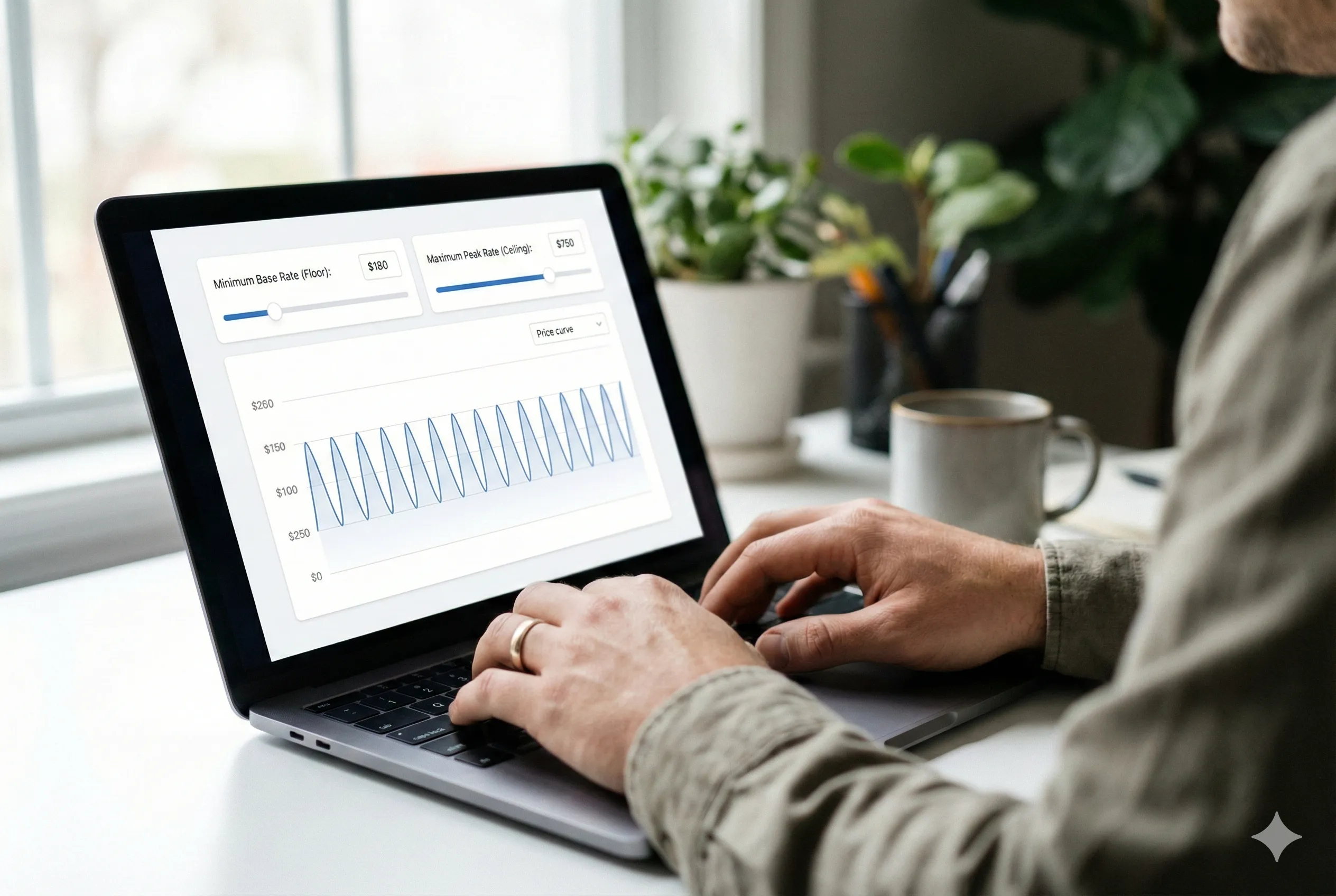
| Dynamic Pricing & Revenue | Manages pricing strategy across seasons and events. | May offer price suggestions, but you have final say. | You set smart rules and use Revenue Management tools for automated pricing. |
| 24/7 Guest Communication | Responds to all inquiries and in-stay messages. | Often handles pre-booking inquiries or after-hours messages only. | You automate responses from a Unified Inbox for all channels. |
| Booking & Calendar Management | Manages all reservations and prevents double bookings. | Manages bookings on one primary channel. | Your calendar syncs instantly and automatically across all sites. |
| Cleaning & Turnover Coordination | Schedules and manages cleaners for every turnover. | You schedule cleaners; they may coordinate access. | You automate scheduling with Tasks Management tools. |
| Maintenance & Repairs | Coordinates vendors for all maintenance issues. | You find and approve vendors; they may coordinate access. | You manage and track maintenance jobs from a central dashboard. |
| Owner Reporting | Provides monthly financial and performance statements. | Provides basic booking reports. | You generate your own detailed performance reports anytime. |
Key factors that influence management fees
Not all properties are quoted the same rate. Managers assess the workload and revenue potential of your listing before presenting a fee.
Property location and market demand
A property in a high-demand tourist destination like Miami or Scottsdale will command a higher nightly rate, making it more profitable for a manager. This competition can sometimes lead to lower percentage fees. Conversely, a property in a remote location with less demand may require more marketing effort, potentially leading to a higher fee.
Property size and type
A six-bedroom house requires more cleaning coordination, maintenance oversight, and guest support than a studio apartment. The manager’s fee will reflect the increased operational workload associated with a larger or more complex property.
Scope of services required
As shown in the table above, the single biggest factor is what you ask the manager to do. If you only need someone to handle guest messaging and check-ins, you’ll pay a co-host rate of 10-15%. If you need them to manage pricing, marketing, cleaning, maintenance, and guest reviews, you’ll pay the full-service rate of 20-30%.
Property performance and occupancy
Managers want to partner with successful properties. If your listing already has a strong history of high occupancy and positive reviews, a manager may offer a more competitive rate because they see it as a reliable source of income with less risk.
Watch out for these additional costs
The commission percentage is the starting point. Read the management agreement carefully to find other potential costs charged on top of the base fee.
- Onboarding or setup fees: Some companies charge a one-time fee of $100-$500 to set up your listing, arrange photography, and integrate your property into their systems.
- Cleaning fees: Clarify if the cleaning fee paid by the guest is a direct pass-through to the cleaning company or if the manager adds a markup. A markup is an extra revenue stream for them and a hidden cost for you.
- Maintenance and repair costs: Most managers coordinate repairs but pass the actual cost on to you. Some also add a service charge (e.g., 10-15%) on top of the vendor’s invoice for the coordination effort.
- Restocking consumables: Check who pays for restocking items like toilet paper, coffee, and soap. Some managers bill this back to the owner monthly, sometimes with a markup.
How to decide if a property manager is worth it
The decision comes down to a simple calculation: is the time and stress you save worth 20% of your gross revenue?
First, calculate the real monetary cost. If your property grosses $50,000 a year, a 20% management fee is $10,000. Ask yourself: could you generate the same or better results and save that money by investing in the right tools?
The modern alternative moves beyond the “DIY vs. Manager” debate. Using a vacation rental software automates the most time-consuming parts of the job. Instead of paying a person $10,000 a year to answer messages and update prices, you can use a platform to do it for you. Guesty®, a vacation rental software, gives you the same operational power as a professional manager.
You can deploy AI agents as your virtual co-host. A tool like ReplyAI can handle many guest messages automatically, using your property data to give accurate, instant answers. An agent like PriceOptimizer adjusts your rates daily based on market demand, handling the same task a human revenue manager would.
A manager’s value is in execution and scale. They promise to list you on more channels to increase bookings. You can do that yourself with a Channel Manager, syncing your calendars automatically across Airbnb, Booking.com, Vrbo, and Expedia. You keep the control, you own the guest relationship, and you keep the commission.
A manager might be worth it if you live far from your property, have zero time or interest in hosting, or want a completely passive investment. But if you want to grow your business efficiently, using software to manage your own operations is the most profitable path forward.