
The line between business and leisure travel has blurred permanently. Remote work flexibility, extended business trips, and the desire to maximize travel opportunities have created a traveler who refuses to choose between productivity and exploration. They want both, and they’re booking properties that deliver.
This blend of business and leisure, often called “bleisure,” now accounts for a significant portion of business travel. For property managers, it represents a lucrative segment that books longer stays, values workspace amenities, and often returns to the same destinations repeatedly.
TL;DR
- Bleisure travelers combine work trips with leisure time, extending stays before or after business commitments.
- They spend minimal time planning the leisure portion, so your listing needs to immediately communicate both work-readiness and local appeal.
- Target conference attendees, remote workers, and business travelers in destinations with strong attractions.
- Offer workspace amenities alongside local recommendations and experiences.
- Build systems to capture repeat bookings from travelers who return to the same cities regularly.
What defines the bleisure traveler in 2026?
Bleisure travel has evolved significantly. What started as millennials tacking a weekend onto a conference trip has expanded across demographics and work styles.
Today’s bleisure traveler:
- Works remotely at least part of the time and can extend trips without taking vacation days
- Attends conferences, client meetings, or industry events that bring them to specific cities
- Values experiences over pure relaxation
- Books accommodations that support both focused work and exploration
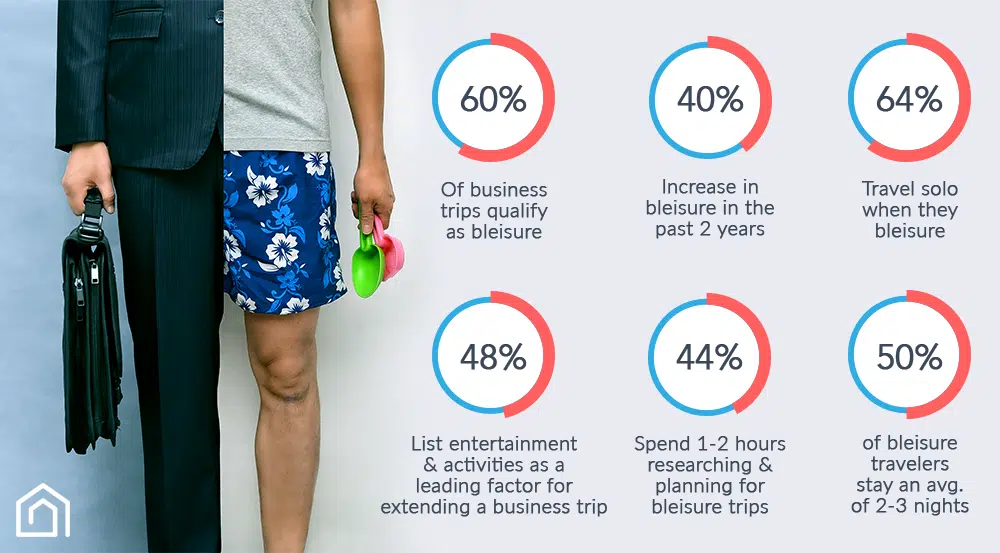
- Often travels solo, though some bring partners or family for the leisure portion
- Returns to the same destinations multiple times per year for recurring business
The technology, consulting, and creative industries have the highest concentration of bleisure travelers, but the pattern has spread across professional services, healthcare, finance, and beyond.
Which destinations attract bleisure bookings?
Business trips convert to bleisure stays when the destination offers something worth staying for. Travelers extend trips in cities with:
- Strong food and restaurant scenes
- Cultural attractions (museums, historical sites, arts)
- Outdoor activities and natural beauty
- Walkable neighborhoods easy to explore between meetings
- Good weather during business travel seasons
- Entertainment and nightlife options
Major business hubs like New York, London, Austin, Miami, and San Francisco naturally attract bleisure travelers. But secondary cities hosting major conferences or industry events see significant bleisure activity too.
If your properties are located near convention centers, business districts, or in cities known for both commerce and culture, you’re positioned to capture this market.
How to position your listing for bleisure travelers
Bleisure travelers don’t spend hours researching accommodations. They need to confirm quickly that a property meets both their work and leisure needs. Your listing must communicate this at a glance.
Listing description strategy:
Lead with details that signal work-readiness and location appeal in the same breath:
- “Quiet home office setup, 10-minute walk to the convention center and downtown restaurants”
- “High-speed WiFi and dedicated workspace in the heart of the arts district”
- “Professional-grade amenities in a neighborhood known for its coffee shops and live music”
Avoid purely leisure-focused descriptions that might make business travelers question whether they can actually get work done.
Conference and event targeting:
Stay current on major conferences, trade shows, and industry events near your properties. When a significant event approaches:
- Update your listing title to reference the event or venue
- Adjust minimum stay requirements to accommodate typical conference lengths plus extension days
- Create messaging that speaks directly to attendees
Guesty’s channel management tools let you update listings across platforms efficiently when targeting specific events.
What amenities do bleisure travelers expect?
The baseline requirements combine business traveler essentials with vacation rental comfort.
Non-negotiables:
- Reliable, high-speed WiFi (test speeds regularly and advertise them)
- Dedicated workspace with comfortable seating and good lighting
- Quiet environment for video calls
- Multiple power outlets and charging stations
- Quality coffee setup
Differentiators:
- External monitor or second screen
- Standing desk option
- Ring light for video calls
- Printer access
- Separate room that can function as an office
Leisure elements:
- Curated local recommendations (restaurants, attractions, activities)
- Outdoor space for unwinding after work hours
- Entertainment options (streaming services, books, games)
- Kitchen facilities for travelers tired of restaurant meals
The goal: a space where someone can take a morning video call, explore the city in the afternoon, and work on a presentation in the evening, all comfortably.
| Guest segment | Primary need | Booking pattern | Key amenities |
| Pure business | Productivity | Short stays (2-3 nights), weekdays | Fast WiFi, workspace, quiet environment |
| Bleisure | Work + exploration | Extended stays (4-7 nights), includes weekend | Workspace plus local recommendations |
| Remote worker | Long-term productivity | Week to month-long stays | Dedicated office, ergonomic setup, kitchen |
| Conference attendee | Proximity + convenience | Aligned with event dates | Walking distance to venue, early check-in |
How to extend bleisure stays
Bleisure travelers are open to extending trips if given a reason. Your job is to make the extension easy and appealing.
Before arrival:
In pre-stay communication, ask about their travel purpose. If it’s business-related, mention that many guests extend their stays to explore the area. Offer a discounted rate for additional nights or a package that includes local experience recommendations.
During the stay:
Check in after their first day. Ask if they’ve had time to explore beyond their business commitments. If they seem interested in local activities, share specific recommendations and mention that extending is easy if their schedule allows.
Incentive structures:
- Discounted rates for stays extending beyond the original booking
- “Business traveler” packages that bundle extra nights with local experience credits
- Loyalty pricing for guests who return to the same property
How to capture repeat bleisure bookings
Business travelers often return to the same cities repeatedly. A guest who attends an annual conference or visits a recurring client represents years of potential bookings.
Build your direct booking channel:
After a successful stay, direct guests to your direct booking website where they can book future stays without OTA fees. Offer returning guest discounts that make direct booking the obvious choice.
Maintain contact:
Save guest information and communication preferences. When major events return to your area, reach out to past business travelers who might attend. A personalized message (“The tech conference is back in March. Would you like to book your usual dates?”) converts at far higher rates than generic marketing.
Use your CRM:
Guest relationship management tools help you track guest preferences, stay history, and business travel patterns. Note which conferences they attended, what amenities they appreciated, and what local experiences they enjoyed. This information personalizes future communications and demonstrates that you remember them.
Partner with local businesses
Since bleisure travelers spend limited time planning their leisure activities, you can add value by doing the research for them.
Build relationships with:
- Restaurants (especially those with good lunch spots for midday breaks)
- Tour operators and experience providers
- Fitness studios and gyms
- Spa and wellness services
- Car services and transportation providers
Negotiate guest discounts where possible. A curated list of vetted recommendations, especially with exclusive offers, differentiates your property from competitors who simply provide a generic guidebook.
FAQs
How do I know if a guest is a bleisure traveler?
Ask in your pre-arrival communication. A simple question like “What brings you to the area?” reveals whether the trip is purely business, purely leisure, or a combination. Guests attending conferences, visiting clients, or mentioning work obligations alongside sightseeing interests are bleisure candidates.
Should I price differently for business versus leisure travelers?
Not necessarily by traveler type, but consider your pricing strategy around business events. Conference weeks often support premium pricing. Offering discounted extension nights after the event ends can capture bleisure bookings that might otherwise go to competitors.
What’s the average length of a bleisure stay?
Typical business trips last two to four nights. Bleisure extensions add one to three nights, making total stays of three to seven nights common. This longer average stay often makes bleisure travelers more profitable than pure leisure guests who book only weekends.
How important is location for attracting bleisure travelers?
Very important. Proximity to business centers, convention facilities, or client offices matters for the work portion. Walkability to restaurants, attractions, and neighborhoods worth exploring matters for the leisure portion. Properties that deliver both have a significant advantage.
Can smaller markets attract bleisure travelers?
Yes, if they host relevant business events. A city with a major industry conference, corporate headquarters, or regional business hub can attract bleisure travelers even without being a traditional tourist destination. Research what brings business travelers to your area and market accordingly.

Guesty’s talented marketing team is comprised of passionate professionals who share insightful industry knowledge and shape brand narratives. By bringing a diverse blend of expertise to the table, we are the visionary architects behind the Guesty brand and innovative campaigns that help people understand our product.