

TL;DR
Static nightly rates don’t reflect how Australians actually travel. Dynamic pricing lets you adjust rates across booking channels such as Airbnb and Stayz, based on demand, seasonality, and local events, so you are not underpriced in peak periods or overpriced in low season.
Key takeaways
- Australian demand is highly seasonal and event-driven, so flat pricing almost always leaves money on the table.
- Dynamic pricing adjusts prices based on demand, adapting seasonally and according to school holidays, coastal peaks, and city events.
- Guesty helps centralise your pricing logic so changes flow consistently to every booking channel, like Airbnb and Stayz, whether you’re a small host or a professional PM.
Why dynamic pricing matters so much in Australia
Australia’s travel patterns run in peaks and valleys. Coastal destinations like the Gold Coast, Sunshine Coast, and Byron Bay can be at near-capacity over summer, school holidays, and long weekends, then noticeably quieter in the shoulder seasons. Sydney and Melbourne see sharp spikes around major events, festivals and long weekends, with softer demand at other times.
If you set one flat rate that “feels fair” for the whole year, it will almost certainly be wrong for certain seasons or events. You may be overpriced mid-week in winter, leading to weak occupancy, and underpriced over Christmas, New Year, or other holiday periods, leaving revenue on the table even when you’re fully booked.
Dynamic pricing tackles this problem by allowing your rates to adapt with the market. Instead of reacting manually to every empty night or sudden spike in searches, you define guardrails and let data-driven rules do most of the work. That is particularly important when you advertise on more than one platform, such as Airbnb or Stayz, and want your pricing to stay aligned with local demand rather than your last guess.
How dynamic pricing works for Australian vacation rentals
Dynamic pricing is simply the practice of adjusting your nightly rates based on how much demand exists for specific dates in your particular market. It’s the same idea airlines and hotels have used for years, adapted for short-term rentals.
Most modern dynamic pricing tools look at a mix of inputs and push rate recommendations into your PMS. For Australian markets, the most important inputs typically include:
- Seasonality: Warmer months on the Gold Coast and Sunshine Coast, winter city breaks, ski season in alpine regions.
- Local events: New Year’s Eve in Sydney, Vivid Sydney, major sporting fixtures in Melbourne, concerts, and regional festivals.
- Day-of-week patterns: Weekend escapes for coastal and regional stays, mid-week corporate and project travel in cities.
- Lead time: How far in advance guests usually book in your market, and how prices should respond when dates are still empty close to arrival.
- Competitive pricing: Market performance, direct competitor benchmarking, and top listings in your market.
Once connected to your PMS, a pricing engine can automatically update rates across Airbnb and other channels. Instead of logging into each platform and changing prices manually, simply set the rules and let the system adjust within the boundaries you’re comfortable with.
Common pricing mistakes Australian hosts make
Many Australian hosts and small operators already have solid properties and good reviews, but their pricing strategy holds them back. Some of the most common mistakes include:
- Using the same nightly rate all year for high-variation markets like Sydney or the Gold Coast, regardless of events or holidays.
- Mirroring an identical price between channels such as Airbnb and Stayz, without recognising that each channel has different guest behaviour and booking windows.
- Reacting emotionally to short-term gaps by slashing prices or hiking them up sharply in the case of high demand, rather than following a consistent system based on data.
These habits create volatility in occupancy and revenue, making it harder to predict cash flow. The goal of dynamic pricing is not constant tinkering, but rather replacing guesswork with a set of rules that work with your market.

Building a dynamic pricing strategy for Australia: a practical playbook
Step 1: Map your local demand patterns
Start by looking at how demand actually behaves in your specific locations, not in abstract. A Sydney CBD or Bondi listing will show very different seasonality from a farmhouse listed on Stayz in the Yarra Valley or Blue Mountains.
For Sydney, list your obvious peaks: New Year’s Eve, key public holidays, Vivid Sydney, major concerts and sporting events, and the summer high season. For Gold Coast and Sunshine Coast properties, focus on Christmas and January holidays, Easter, long weekends, and major local events. For regional escapes, observe the pattern of weekend getaways versus mid-week stays.
Even a simple spreadsheet of “peak weeks, shoulder weeks, and low weeks” for each market will give you a clearer picture of where your static pricing is out of sync.
Step 2: Set your floor, ceiling, and “normal” rate
Next, decide on three anchors instead of one fixed price:
- A minimum “walk-away” rate that covers your costs and target margin, even in softer periods.
- A base range you are comfortable with for shoulder-season dates when demand is steady but not extreme.
- A realistic cap for peak weeks, major event periods, and school holidays when demand is highest.

When you calculate your floor, include not just mortgage or rent but cleaning, utilities, insurance, platform fees, and any local council requirements. This ensures that when a pricing engine reduces rates to fill gaps, it never cuts below what makes sense for your business.
Step 3: Choose and configure a dynamic pricing tool
Once you understand your demand and pricing anchors, the next step is to choose a dynamic pricing tool and connect it to your PMS. The goal is not to replace your judgment, but to give you automatic, data-driven recommendations that respond faster than manual updates ever could.
For Australian markets, the most useful tools are those that can factor in local occupancy, competitor pricing, seasonality, and high-profile events. They should allow you to configure minimum and maximum prices, adjust markups for specific dates, and set different strategies for different property types or locations.
An even better solution is a dynamic pricing tool embedded directly in your PMS. With PriceOptimizerTM built into Guesty, recommendations flow automatically into your multi-calendar and connected channels, saving hours of manual effort and eliminating the need to juggle platforms.
Step 4: Align pricing across channels
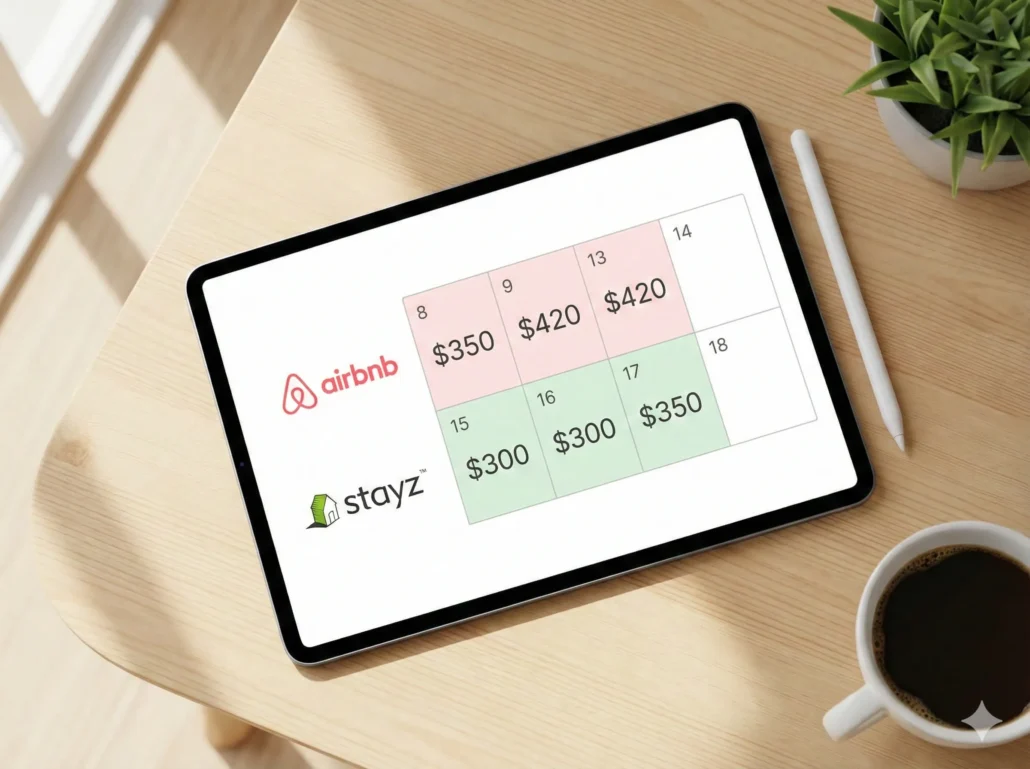
Different channels attract different guest types. Airbnb might lean heavily on international visitors and domestic travellers looking for city stays or event trips. Stayz is a natural fit for families planning longer coastal holidays.
Your dynamic pricing strategy should reflect these differences without becoming inconsistent or chaotic. With an advanced PMS like Guesty, you can:
- Set a core pricing strategy that applies across all channels.
- Layer small channel-specific adjustments (for example, a modest markup on channels with higher commissions or longer stays).
- Tailor minimum night stays to the audience: longer minimums on Stayz over school holidays and slightly more flexible options on Airbnb mid-week.
With Guesty acting as the source of truth for pricing and availability, you can maintain alignment while still acknowledging how each channel behaves.
Step 5: Review performance and refine the rules
Dynamic pricing is most effective when you check in regularly and refine your guardrails, not when you set it once and ignore it. The key is balancing the data with human oversight and expertise.
A simple monthly review is enough for many operators. Look at occupancy and average daily rate (ADR) by property and by period. Identify dates that were fully booked very early and may have been underpriced, as well as dates with persistent vacancies that may signal overly aggressive pricing or minimum stay requirements.
From there, adjust your floors, ceilings, and “special event” markups. The idea is to refine your rules over time so the pricing engine gets closer to your ideal balance of occupancy and rate without daily manual interference.
How Guesty supports dynamic pricing for Australian hosts and property managers
You can run a basic dynamic pricing setup by connecting a pricing tool directly to platforms like Airbnb. However, as soon as you manage multiple properties, multi-channel distribution, or owners who want transparent reporting, you need a system to orchestrate everything.
Guesty: Your pricing and channel hub
Guesty acts as your pricing and availability hub across Airbnb, Stayz, Booking.com, and a large range of other channels. Guesty has its own embedded dynamic pricing tool, Guesty PriceOptimizerTM, which flows directly into a central multi-calendar and each channel according to your rules.
This has several advantages:
- You maintain one source of truth for rates, availability, and restrictions.
- Channel-specific strategies live inside a consistent framework instead of isolated dashboards.
- You can report on revenue and occupancy by property, owner, and market using the same underlying data that drives your pricing decisions.
Guesty for Australian portfolios
The difference between a good year and a great one often comes down to how you price the peaks—and whether you fill the valleys. Dynamic pricing helps you do both, without continual manual updates across multiple platforms.
Guesty centralises your pricing strategy so changes flow to Airbnb, Stayz, and every other channel from one place. Set your guardrails, review monthly, refine as you learn. The market moves. Your pricing should too.
FAQs
Yes. Even with a small portfolio, Australian demand swings sharply between peak holiday periods, event weeks, and quieter seasons. A dynamic pricing setup can noticeably improve both occupancy and revenue, especially in markets like Sydney, Melbourne, and the Gold Coast.
A monthly review is enough for most operators. You can dive deeper before key periods such as summer holidays or major events, but you do not need to tweak settings every day. The aim is to refine your rules based on performance, not to micromanage individual nights.
Not necessarily. It’s wise to start with a consistent base strategy and then make moderate channel-specific adjustments that reflect audience, booking window, and commission structures. Guesty helps you keep this under control by centralising rates and availability and applying channel rules in one place.
A pricing engine can suggest excellent rates, but without a PMS you will still have to manage availability, channel connections, owner relations, and operations in fragmented ways. Guesty unites pricing, distribution, communications, and reporting so that dynamic pricing becomes part of a coherent business system, not just another standalone dashboard.

Guesty’s talented marketing team is comprised of passionate professionals who share insightful industry knowledge and shape brand narratives. By bringing a diverse blend of expertise to the table, we are the visionary architects behind the Guesty brand and innovative campaigns that help people understand our product.