
TL;DR
While serious property damage is an inherent risk in the short-term rental industry, minor theft and incidental damage constitute more of the daily reality. Relying on memory or paper checklists leaves you exposed to both. The most effective strategy to prevent damage and loss combines digital inventory tracking with seamless insurance coverage. By integrating condition reports into your cleaning workflow and utilizing tools like Guesty Damage Protection™, you can shift the financial risk off your balance sheet without creating friction for your guests.
Preventing loss in vacation rentals isn’t just about stopping a guest from taking a towel; it’s about establishing a system of accountability that handles everything from a broken wine glass to a broken oven.
For professional property managers, the goal is to protect net income. A missing remote control is an annoyance, but a stained sectional or a scratched hardwood floor is a significant capital expense. Without a standardized process to document the condition of your property before and after every stay, these costs compound unnoticed until they impact your profitability.
Here is an effective operational framework for securing your assets and managing disputes in 2025 and beyond.
The psychology of prevention
Deterrence begins before the guest arrives, with the condition of the property setting the standard for how it is treated. A spotless, well-maintained home signals that the manager is attentive and professional, which subtly encourages guests to respect the space. Conversely, a property that already shows signs of wear—scuffed walls, mismatched cutlery, or stained carpets—signals that “one more scratch won’t matter.”
- The “par level” concept: Instead of counting every individual fork, establish a “par level” for your inventory (e.g., 12 place settings for a 6-person home). If the count falls below par, a restocking task is triggered.
- Digital presence: Visible exterior security cameras and smart locks do more than secure the perimeter; they signal that the property is professionally managed. Guests are less likely to act negligently when they know access is tracked digitally.
Why paper checklists fail
Paper checklists are static, easily lost, and provide no proof of condition. In a dispute, a checked box on a piece of paper is rarely sufficient evidence to claim damages from an OTA (online travel agency) or an insurance provider.
Digital inventory systems provide three critical advantages:
- Time-stamped evidence: Photos taken at checkout provide irrefutable proof of the property’s condition at a specific moment. This is your primary defense against the “it was already like that” argument.
- Accountability: It forces the inspection to happen. You know exactly when the cleaner completed the checklist, ensuring the property was actually reviewed.
- Data continuity: You can track how often specific items go missing or break over time, allowing you to adjust your purchasing strategy. If you replace the coffee maker three times in a month, the problem might be the appliance’s complexity, not the guests.
Operationalizing the check
The inspection must be an integral part of the turnover workflow, not an afterthought. If it relies on a manager driving to the property, it will eventually fail due to lack of bandwidth. The check must be executed as a standard protocol by the cleaning team on the ground.
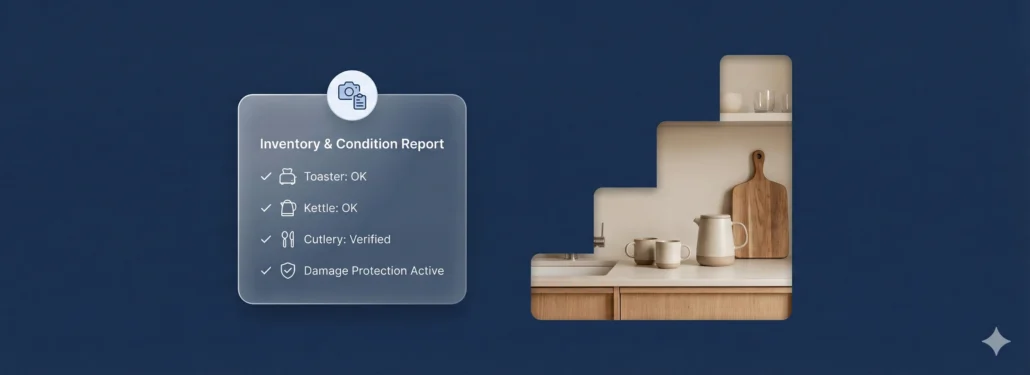
Using Guesty Tasks Management™, you can embed the inventory and condition check directly into the turnover schedule.
- Pre-arrival inspection: The cleaner confirms the property is stage-perfect. This “before” photo is crucial for disputing claims later.
- Post-departure inspection: The cleaner snaps photos of key high-value zones (electronics, art) and high-risk zones (linens, kitchen counters, flooring).
- The feedback loop: If an item is reported missing or damaged, it is noticed right away (and can even trigger a message to relevant team members) for immediate resolution.
Navigating guest disputes
The most difficult part of property management isn’t fixing the damage — it’s recovering the damage costs. Disputes over guest damages often devolve into he-said-she-said arguments that platforms like Airbnb or Vrbo settle based on evidence.
To win a dispute, your documentation must be airtight. You need a photo of the undamaged item from before the check-in and a photo of the damage from immediately after checkout. This is why timestamped photos uploaded to your task management software are essential.
When you do find damage, communication is key. Avoid accusatory language. Instead, state the facts neutrally: “Dear Guest, our cleaning team noticed the coffee table glass was shattered during their post-checkout inspection. Here are the photos timestamped at 11:30 AM today. As per our policy, we will need to open a claim to cover the replacement.”
Wear and tear vs. damage
A common friction point in disputes is defining “damage.” Platforms generally protect guests from having to pay for normal wear and tear.
- Wear and tear: The natural costs of doing business, such as minor scuffs on luggage-loading walls, loose cabinet handles, or fading carpet.
- Damage: Insurable events that are outside the realm of normal usage, such as damaging red wine spills on the rug, a hole in the drywall, or a broken window.
Professional managers budget for wear and tear but insure against damage. Trying to charge a guest for a loose doorknob will likely result in a lost dispute and a bad review.
When prevention fails: Damage protection
Even the best systems cannot prevent accidents. A guest trips and breaks a table; a suitcase scratches a wall. In these moments, the mechanism for recovery matters more than the prevention.
In addition to covering costs, guest satisfaction becomes a critical factor. Traditional security deposits cause friction because they increase the upfront cost for the guest and create an adversarial relationship when you have to withhold funds. Dealing with damage claims after the fact can lead to disputes and bad reviews. No matter how happy a guest is with their stay, there’s no surefire way to demand compensation for damage and still get a 5-star review.
Guesty Damage Protection™ offers a modern alternative.
- Zero friction: It acts as coverage included in the reservation, removing the need for a large hold on the guest’s credit card and eliminating guest involvement in making a claim.
- Seamless claims: Because the coverage is integrated into the property management software (PMS), you can file and manage the claim directly from the Guesty dashboard.
- Higher coverage: Plans can cover up to $20,000, protecting you against significant losses that a standard $500 deposit would never cover. The coverage includes both contents (including fixtures and furnishings), as well as damage to the property itself caused by guests.
FAQs
Rely on your data. Provide the timestamped pre-stay and post-stay photos. If you are using Guesty Damage Protection, the claims process is handled by the provider, removing you from direct conflict with the guest.
Perform a “par level” check at every turnover (focusing on essentials). Conduct a full, deep-dive inventory audit quarterly to catch slower operational drift, such as the gradual loss of Tupperware or hangers.
Yes. Many digital tools help to safeguard your property from theft. For example, Guesty Locks Manager™ ensures that access codes expire exactly at checkout. This prevents unauthorized re-entry, which is a common window for theft. Additionally, smart thermostats and noise monitors signal that the home is “active” and connected, acting as a psychological deterrent.
Small electronics (chargers, portable speakers), linens (towels, pillows), and decorative items are the most frequent targets. High-value items like TVs are rarely stolen but often damaged.