
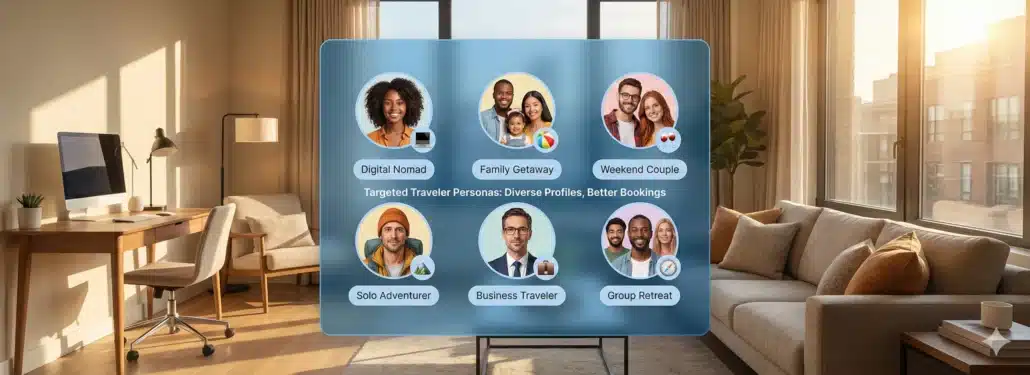
TL;DR: Traveler personas are fictional profiles of your ideal guests built from booking data, surveys, and competitor research. Creating 2–3 detailed personas helps you target marketing, personalize communication, and convert more inquiries into bookings. This guide walks through the six-step process and includes 10 ready-to-customize persona templates.
Understanding your target audience is key to successful vacation rental marketing. While beautiful properties and excellent service are essential, you can enhance your marketing efforts by creating traveler personas, meaning fictional representations of your ideal guests.
We’ll break down the value of developing traveler personas and provide a step-by-step guide to creating them effectively.
Why do traveler personas matter for vacation rental marketing?
First off, knowing your guests’ preferences and behaviors creates more targeted marketing campaigns for your vacation rentals. Instead of using a one-size-fits-all approach, you can tailor your messaging, visuals, and offerings to meet the precise needs and desires of your potential short-term rental guests.
Also, by understanding your guests’ communication preferences and pain points, you can establish better ways to stay in touch with them, whether by Facebook Messenger, LinkedIn, WhatsApp, or email marketing. This enables you to respond promptly to inquiries, address concerns, and provide exceptional customer service, leading to higher guest satisfaction and positive reviews.
And of course, this can result in repeat bookings, referrals, and higher occupancy rates for your vacation rentals.
See our guide to vacation rental marketing strategies.
How do you develop a vacation rental traveler persona?
Step 1: Collect data about past guests
Analyze booking histories, guest reviews, and feedback to identify common trends and characteristics among your guests. Consider factors such as age, gender, nationality, travel purpose, and booking behavior.
If you’re managing 1–4 properties with Guesty Lite, your Unified Inbox gives you a single view of all guest communications across Airbnb, Vrbo, Booking.com, and direct channels, making it easier to spot patterns in who’s booking and why.
Step 2: Conduct surveys
Reach out to your previous guests with surveys or questionnaires to gather additional insights. Ask questions about their preferences, reasons for choosing your vacation rental property, and what they valued most during their stay.
Step 3: Analyze your competition
Research your competitors’ guest demographics and offerings. This can help you identify gaps in the market or unique selling points that set your property apart.
Step 4: Segment your audience
Based on your collected data, split your audience into distinct traveler personas. These personas should represent different types of vacation rental guests who are likely to stay at your property.
For each persona, create a detailed profile. Include information such as name, age, occupation, travel motivations, preferences, and pain points. The more specific and detailed your persona profiles are, the better you can tailor your marketing efforts. See our templated list of ideas below to help you kick this off.
Step 5: Create your vacation rental marketing plan
Once you have your traveler personas in place, customize your marketing strategies accordingly. Develop content, visuals, and promotions that resonate with each persona. For example, if one persona values family-friendly amenities, highlight your property’s child-friendly features in your marketing materials.
Step 6: Monitor and adjust
Continuously survey the effectiveness of your vacation rental marketing efforts and collect feedback from guests. Use this data to refine your traveler personas and marketing strategies over time.
10 vacation rental traveler persona templates
Not sure how to start creating your traveler personas for your vacation rental marketing strategy? Check out these 10 typical vacation rental travelers and adjust any of these to create your personas.
Alex, the business traveler
- Age: 30–45
- Occupation: Business professional
- Travel purpose: Work-related trips
- Preferences: Convenient location, high-speed Wi-Fi, a dedicated workspace
- Marketing angle: Emphasize proximity to business districts, reliable internet speed, and quiet workspaces
Sarah and Mark, the vacationing family
- Age: 30–40
- Travel purpose: Family vacations
- Preferences: Kid-friendly amenities, spacious accommodations, proximity to family-friendly attractions
- Marketing angle: Highlight safety features, entertainment options for children, and nearby activities
Emily, the solo adventurer
- Age: 25–35
- Travel purpose: Adventure and exploration
- Preferences: Budget-friendly options, proximity to outdoor activities, local experiences
- Marketing angle: Feature access to hiking trails, local guides, and authentic neighborhood experiences
Mia and Daniel, the romantic couple
- Age: 25–35
- Travel purpose: Romantic getaways
- Preferences: Privacy, cozy atmosphere, romantic touches (candles, jacuzzi, wine)
- Marketing angle: Lead with ambiance photos, couple-focused amenities, and local dining recommendations
Olivia, the luxury seeker
- Age: 40+
- Travel purpose: High-end vacations
- Preferences: Upscale amenities, luxury furnishings, concierge services
- Marketing angle: Showcase premium finishes, exclusive services, and attention to detail
James, the digital nomad
- Age: 25–40
- Occupation: Remote worker or freelancer
- Travel purpose: Combining work and leisure
- Preferences: Reliable Wi-Fi, comfortable workspace, access to cultural experiences
- Marketing angle: Promote internet speed tests, ergonomic work setups, and monthly stay discounts
Elena, the local explorer
- Age: 30–50
- Travel purpose: Exploring their own city or region
- Preferences: Unique and offbeat accommodations, insider tips on local attractions and eateries
- Marketing angle: Highlight what makes your property different from staying home — the staycation appeal
Sophie, the wellness enthusiast
- Age: 30–50
- Travel purpose: Wellness and relaxation
- Preferences: Yoga or spa facilities, proximity to nature, healthy dining options
- Marketing angle: Feature outdoor spaces, wellness amenities, and nearby nature escapes
David, the budget-conscious traveler
- Age: 20–35
- Travel purpose: Traveling on a budget
- Preferences: Affordable rates, access to public transportation, self-catering options
- Marketing angle: Emphasize value, kitchen facilities, and cost-saving tips for the area
Chris, the event attendee
- Age: Varies based on event type
- Travel purpose: Attending local events or festivals
- Preferences: Proximity to event venues, flexibility in booking dates
- Marketing angle: Create event-specific landing pages and highlight distance to major venues
Turning personas into personalized communication
The real payoff from persona work comes when you use it to automate personalized guest communication. Instead of generic check-in instructions, send messages that speak to what each guest type actually cares about.
A business traveler gets Wi-Fi passwords and coffee shop recommendations front and center. A family gets the high chair location and nearby playgrounds. Same property, different message, significantly higher guest satisfaction scores.
With automated messaging workflows, you can create persona-specific templates that trigger based on booking details. Tag reservations by guest type, and let your system do the personalization work.
Personas are key to hyper-personalization
Developing traveler personas for your short-term rental marketing strategy can significantly enhance your business’s success. By understanding your guests on a deeper level and tailoring your marketing efforts accordingly, you can attract the right audience, provide exceptional guest experiences, and ultimately increase your vacation rental occupancy rates and revenue.
Take the time to invest in creating detailed traveler personas, and you’ll see the results in satisfied guests and a thriving property management rental business.
Frequently asked questions
Start with 2–3 personas that represent your highest-value or most frequent guest types. Too many personas dilute your focus; too few miss key segments. Expand only when you have enough booking data to support additional profiles.
Review your personas annually or whenever you notice significant shifts in your booking patterns. Seasonal changes, new amenities, or targeting a new market segment all warrant a persona refresh.
If your properties serve different markets (beach house vs. city apartment), you’ll likely need different personas for each. Properties in the same area with similar amenities can often share personas.
A target market is broad (families with young children). A persona is specific (Sarah and Mark, 35, two kids under 8, drive 4 hours for weekend getaways, prioritize outdoor space and Netflix access). Personas put a face on your market segments.
Post-stay surveys with 3–5 questions have the highest completion rates. Offer a small incentive like a discount on future stays. Review your existing booking notes and communications for patterns you already have but haven’t analyzed.
Managing 1–4 properties? Guesty Lite gives you the unified inbox and automated messaging tools to put persona-based communication on autopilot — without the complexity of enterprise software.