

For short-term rental hosts, understanding the difference between hosting on Booking.com and Airbnb is critical to choosing the right mix of channels for your business.
TL;DR: Booking.com vs Airbnb for hosts
- Guest vetting: Airbnb offers stronger guest verification and two-way reviews; Booking.com doesn’t let you review guests
- Guest expectations: Airbnb guests expect a home; Booking.com guests often expect hotel-like standards
- Fees: Similar overall distribution cost in most markets—Booking.com charges pure commission to hosts; Airbnb splits fees between hosts and guests
- Cancellations: Higher free-cancellation rates on Booking.com due to “book now, pay later” norms
- Best practice: List on both platforms and use a channel manager to avoid double bookings
If you’re a short-term rental host, it’s important to understand how the platform operates and where it differs from Airbnb.
While these differences may seem confusing at first, many hosts list on multiple sites to maximize revenue. The effort to understand Booking.com is worth the time and energy. Here are the critical differences, and how to make them work for you.
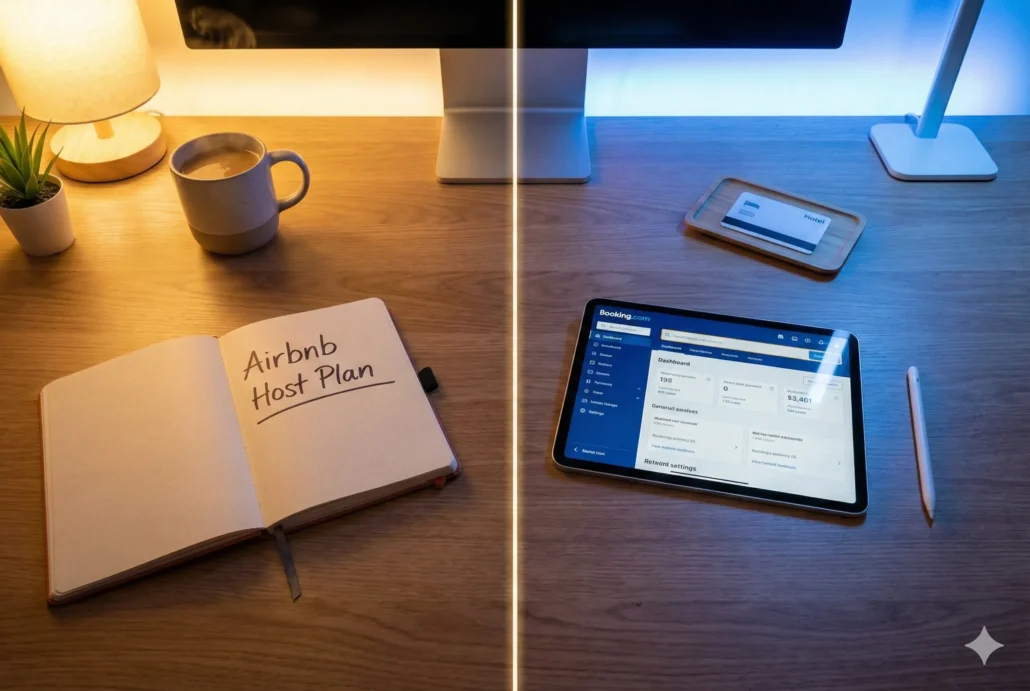
How do guests differ between Airbnb and Booking.com?
Verification and reviews
Airbnb offers two-way reviews where you can leave feedback for your guests—helpful for keeping guests accountable. You can also check reviews of potential guests before accepting a request.
Booking.com doesn’t have this. You can’t review guests, and you won’t see their track record before they book.
Pre-booking communication
On Airbnb, guests often message with questions (including discount requests) before booking. You might answer dozens of questions and still get a notification that they booked elsewhere.
On Booking.com, reservations typically confirm without prior conversation. Less back-and-forth, but also less screening.
Guest expectations
Airbnb guests know they’re staying in someone’s home. They generally don’t expect hotel-level service.
Booking.com guests are used to browsing hotels, and often expect hotel-like standards: 24-hour check-in, complimentary towels and toiletries, instant responsiveness.
What this means for your operations
On Airbnb, plan for more pre-booking questions. Use messaging templates or automation to handle volume efficiently.
On Booking.com, invest more in clear, detailed listing descriptions and hotel-like amenities. You’ll often confirm bookings with zero prior conversation, so your listing needs to answer questions upfront.

How much will you be charged?
Every transaction involves two parties: the guest and the host. The platforms handle fees differently.
Airbnb charges both parties—a service fee to guests and a host fee to you.
Booking.com doesn’t charge guests a platform fee. Instead, it charges hosts a commission on the total booking price, paid at the end of each month.
The real comparison
On Airbnb, total fees are split between you and your guests. On Booking.com, guests see no platform fee, but you pay commission on the booking.
In practice, both channels take a similar share of the booking value in most markets. Your job is to build those costs into your pricing rather than treating one platform as “free.”
Why adjusting rates per channel matters
If you list the same nightly rate on both platforms without accounting for fee structures, you’ll erode your margin on one of them.
Example: If you earn $100 net on Airbnb after its fees but forget to adjust your Booking.com rate for commission, you might only receive $85–$90 for the same stay. Over a year, that gap adds up quickly, especially on high-demand dates.
How to handle payment issues
Airbnb collects payment on your behalf and pays you through your payout method on check-in day. Simple.
Booking.com traditionally requires you to handle payments yourself. When someone books, you receive a credit card number to guarantee the reservation—but that information is only accessible for 10 days after booking.
The no-show and cancellation risk
If a guest cancels at the last minute or doesn’t show up, and you no longer have access to their card information, you’re left with an empty property and no payment.
Payments by Booking.com
Today, you can choose between collecting payments yourself or using “Payments by Booking.com,” where the platform charges guests and pays you via virtual card or bank transfer.
Handling payments yourself gives you more control but exposes you to no-show and card issues. Letting Booking.com process payments reduces that risk but usually comes with an extra processing fee on top of commission.
How to protect yourself
If you handle payments yourself, consider taking deposits or pre-authorizations and using automated reminders so you can charge cards before the free-cancellation window closes. A PMS like Guesty with an intelligent channel manager can help you track which stays are fully paid and which still require action.
Cancellation policies and risk
Airbnb: Prepayment reduces cancellations
Airbnb offers multiple cancellation policies (flexible, moderate, firm, strict, non-refundable). Guests pay when they book, so cancellations are rarer—and more painful for them. When creating your listing, you choose a policy and decide whether to keep the booking amount if a guest cancels.
Booking.com: Free cancellation is the norm
Most Booking.com properties don’t require prepayment and offer free cancellation. Great for guests, risky for hosts. While you can offer non-refundable rates, guests typically choose the flexible option when it’s available.
What this means for you
On Airbnb, prepayment creates commitment. Cancellation rates are lower.
On Booking.com, “book now, pay later” with generous free cancellation means cancellations are more common. You need to watch pick-up closer and keep calendars synced to resell cancelled nights quickly.
If you list on both platforms, adjust your calendar regularly and make sure there’s no mismatch between your Airbnb and Booking.com availability.
Pros and cons of adding Booking.com alongside Airbnb
Demand and visibility
Pros:
- More reservations for vacant nights
- Greater visibility (Booking.com’s massive user base)
- Bookings with less prior conversation
- Higher booking rate (instant confirmation)
Operations and risk
Cons:
- More complicated payment handling (if you manage it yourself)
- No guest reviews to screen bookings
- Higher cancellation rate due to free-cancellation norms
- Constant need for calendar synchronization
By listing on Booking.com, you can create extra revenue for unoccupied nights and avoid putting all your eggs in one basket—but only if you manage the operational complexity.
How Guesty helps
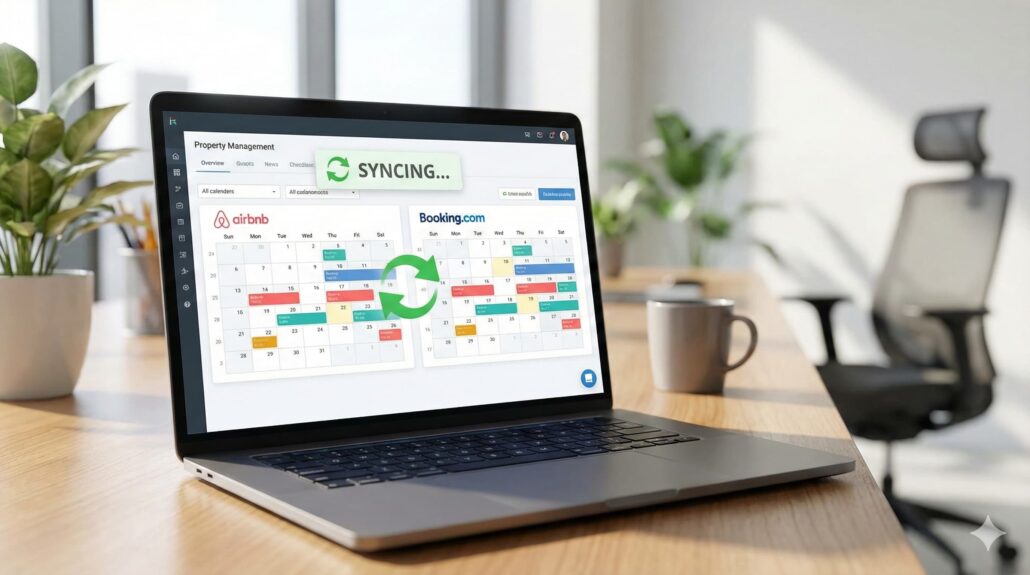
Once you’re on both platforms, your biggest risk isn’t just choosing the “right” OTA—it’s managing calendars, pricing, and policies so they work together instead of against you.
Imagine two guests arriving at the same property on the same day: one from Airbnb, one from Booking.com. That’s a nightmare scenario.
Guesty’s channel manager syncs your Airbnb and Booking.com calendars in real time. When you get a reservation on Booking.com, it immediately blocks those dates on your Airbnb calendar (and vice versa).
Guesty’s pricing tools let you apply different markups per channel so you can offset higher commissions without manual rate changes. Update prices from a single calendar, and your nightly rates adjust accordingly across both platforms.
Guesty’s Unified Inbox brings messages from both channels into one place, so you can respond faster without switching between apps.
The key to getting more reservations is listing on multiple channels and syncing them with a hassle-free tool. Guesty gives you the flexibility to manage your properties professionally, on the go.
Decision framework: Which platform should you use?
Lead with Airbnb if:
- You value guest vetting and two-way reviews
- Your property suits home-like stays over hotel expectations
- You prefer prepayment and lower cancellation risk
Add Booking.com if:
- You want access to hotel-like demand and Booking.com’s massive audience
- You’re ready to handle higher cancellation rates and payment complexity
- You have vacant nights you want to fill
Use both if:
- You want maximum visibility and occupancy
- You’re willing to invest in operations (or use a channel manager/PMS)
- You can handle—or automate—different pricing and policies per channel
In practice, most professional hosts use both platforms. But only with a channel manager or PMS to prevent double bookings and keep pricing consistent.
FAQ
Neither is universally “better.” Airbnb offers stronger guest vetting and lower cancellation risk; Booking.com offers massive reach and hotel-like demand. Most professional hosts list on both and use tools to manage the complexity.
Yes. Many hosts do. The key is keeping calendars synced so you don’t get double-booked. A channel manager or PMS handles this automatically.
Use a channel manager that syncs calendars in real time. When a reservation comes in on one platform, it automatically blocks those dates on the other.
Booking.com has guest reviews of properties, but hosts cannot review guests. You won’t see a guest’s track record before they book, unlike Airbnb’s two-way review system.
The fee structures differ (Booking.com charges host-only commission; Airbnb splits fees between host and guest), but total distribution cost is similar in most markets. Build fees into your pricing on both platforms.
Not necessarily. Because fee structures differ, you may want to adjust rates per channel to maintain consistent net income. Pricing tools can automate this.