The “Vrbo vs. Airbnb” debate is a constant in owner forums and host meetups. For a professional property manager, it’s the wrong question. You aren’t choosing a favorite platform; you’re building a distribution strategy to maximize revenue across a portfolio. The focus shifts from which platform to use to how to manage both effectively without creating operational chaos.
Choosing one platform over the other means leaving money on the table. Each channel gives you access to a different slice of the market, from families booking their annual vacation on Vrbo to solo travelers and couples finding unique stays on Airbnb. A profitable strategy captures demand from both. This guide covers the operational realities of building a scalable, multi-channel business.
TL;DR
- Multi-channel is mandatory: Listing on both Airbnb and Vrbo is essential for maximizing visibility, occupancy, and revenue.
- Segment your portfolio: Airbnb excels with unique stays, apartments, and urban locations, while Vrbo is dominant for traditional vacation homes in destination markets that attract families and groups.
- Analyze fee impact: Vrbo’s annual subscription can lower costs on high-performing properties, while Airbnb’s host-only fee gives you control over the final price guests see.
- Anticipate operational drag: Managing two platforms manually creates major bottlenecks in communication, calendar management, and pricing updates that limit your ability to scale.
- Centralization is the solution: The only way to manage both channels efficiently is with vacation rental management software that syncs your calendars, unifies your inbox, and automates pricing.
The real challenge is managing both
For a solo host with one property, toggling between two apps is manageable. For a professional manager with a team, 10 properties, and a reputation to protect, it’s an operational nightmare. Every new listing doubles the administrative work. Your team is stuck managing separate inboxes, manually updating two calendars, and trying to keep pricing consistent.
This complexity is the single biggest barrier to scaling. Growth stalls when manual processes can’t keep up with your portfolio. This comparison will help you understand the unique strengths of each platform, build a strategy that uses both, and implement systems to manage them from a single place.
Vrbo vs. Airbnb: Key differences at a glance
This table breaks down the core differences from a property manager’s perspective. Use it as a guide for deciding which channel should be the primary focus for different properties in your portfolio.
| Attribute | Airbnb | Vrbo (Vacation Rentals by Owner) |
|---|---|---|
| Best For | Unique stays, urban apartments, short getaways | Traditional vacation homes, destination markets |
| Property Types | Entire homes, private rooms, shared spaces, experiences | Almost exclusively entire homes |
| Typical Guest | Solo travelers, couples, digital nomads, budget-conscious | Families, larger groups, longer stays |
| Host Fee Structure | Split-fee (3%) or Host-only fee (14-16%) | Pay-per-booking (8%) or Annual subscription ($499) |
| Host Status Program | Superhost | Premier Host |
| Cancellation Policies | Wide range, from flexible to strict | Fewer options, generally stricter for guests |
Audience and inventory: Where do your properties fit?
The most fundamental difference between the platforms is their inventory and the audience it attracts. Airbnb started with shared spaces and maintains a brand built on unique experiences and stays. It lists everything from a spare room in Brooklyn to a treehouse in Costa Rica. This variety attracts a broad audience, including younger travelers, couples, and those looking for short, flexible trips.
Vrbo has always focused on “vacation rentals.” It’s a marketplace for entire homes, cabins, and condos in classic vacation destinations. Their core audience is families and larger groups planning their holidays. They book further in advance, stay longer, and are less price-sensitive than the typical Airbnb guest.
For your portfolio, this means segmentation. That two-bedroom urban loft downtown will likely perform best with Airbnb as its primary channel. The four-bedroom house with a pool near the beach is prime Vrbo territory. While you should list both properties on both channels, knowing your primary audience helps you tailor your descriptions, photos, and house rules.
A manager’s guide to fees and revenue potential
Managing channel fees directly impacts margin protection and pricing control. Each platform offers different models that you can use to your advantage.
Airbnb’s fee structure: Flexibility for your listings
Boost your short term rentals today
Airbnb primarily uses a split-fee model where you pay around 3% and the guest pays a service fee of about 14%. However, professional managers should focus on the host-only fee. Here, you absorb the entire fee (typically 14-16%), and no additional service fee is shown to the guest. This gives you total control over the final price, which simplifies pricing psychology and can increase conversion rates. You simply bake the fee into your nightly rate.
Vrbo’s fee structure: Simplicity for planning
Vrbo offers two options. The pay-per-booking model charges you 5% commission and a 3% payment processing fee for each booking. The more strategic option for a successful property is the annual subscription of $499. If a property generates more than roughly $6,250 in booking revenue per year on the platform, the flat fee becomes more profitable than paying 8% on every booking. This makes financial forecasting much simpler for your high-performing listings.
To effectively manage these different fee structures, you need the ability to apply channel-specific pricing rules. With Guesty’s Revenue Management tools, you can set custom markups for each channel, ensuring your rates on Airbnb and Vrbo automatically account for the different commission structures to protect your margins.
Operational deep dive: Policies, bookings, and communication
The differences between Airbnb and Vrbo directly impact your team’s daily workflows.
Cancellation policies: Balancing flexibility and protection
Historically, Vrbo has offered policies that are more favorable to owners, providing stronger protection against last-minute cancellations. Airbnb offers a wider spectrum of options, from flexible to strict, but the platform culture often leans toward guest flexibility. For a manager, this is a risk calculation. Stricter policies on Vrbo can secure revenue further out, but Airbnb’s flexibility might attract more last-minute bookings to fill occupancy gaps.
Booking process: Instant book vs. request to book
Both platforms heavily favor Instant Book, which improves your listing’s visibility in search results. It’s great for maximizing occupancy but can sometimes lead to problematic bookings if guest expectations aren’t managed perfectly. The “Request to Book” feature gives you more control, but the friction can cost you bookings. A common operator mistake is leaving Instant Book off for fear of bad guests, when a better guest screening process is the real solution.
Communication and team management
Here’s the biggest operational hurdle for a scaling team: communication. Without a centralized system, your team is trying to manage conversations in two separate inboxes. A guest message on Airbnb can be missed while an urgent request on Vrbo goes unanswered. There’s no single source of truth, making team collaboration, shift handovers, and quality control nearly impossible. This is where you see response times suffer and five-star reviews slip.
This siloed approach is not scalable. To fix it, you need a Unified Inbox, which consolidates all messages from every channel, including email and SMS, into a single thread per guest. Your entire team can see the conversation history, assign tasks, and respond without ever leaving their dashboard.
How to manage Airbnb and Vrbo without the chaos
Listing on both platforms is non-negotiable for growth. Trying to manage them manually is unsustainable. The strategy inevitably breaks down, leading to costly errors that damage your revenue and reputation:
- Double bookings: A guest books your property on Airbnb, but you forget to block the dates on Vrbo, a common and damaging manual error.
- Pricing errors: You update your weekend rates on one channel but not the other, leaving money on the table or appearing inconsistent to potential guests.
- Calendar clutter: Your team tries to piece together availability by looking at two different calendars, making it impossible to get a clear view of your portfolio’s performance.
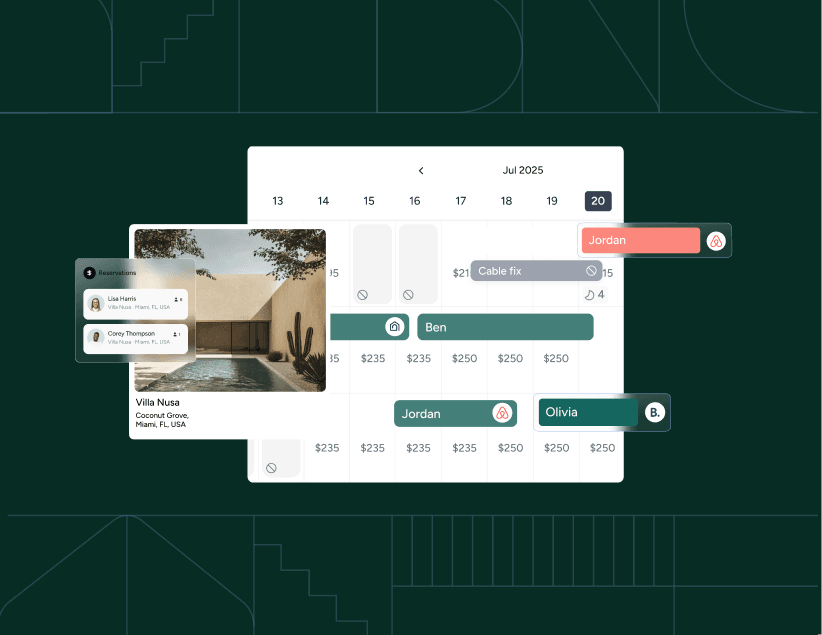
The solution is to use a Channel Manager to act as the central nervous system for your distribution. It automatically syncs your rates, availability, and reservations across all your channels in real-time. When a booking comes in from Vrbo, the dates are instantly blocked on Airbnb and your direct booking site. It all feeds into a Multi-Calendar, giving you a single, reliable view of your entire business.
Scaling your portfolio with Guesty
As your business grows, your operational needs evolve. For hosts just starting to feel the pain of managing multiple channels, Guesty® Lite™ offers the essential tools to automate daily tasks across 1-3 properties. When you’re ready to grow your team and portfolio, Guesty Pro™ provides the powerful, sophisticated features needed to manage 4-499 listings, from trust accounting to advanced analytics. And for large-scale operators, Guesty Enterprise™ delivers custom solutions to support 500+ properties. The platform is designed to be the engine inside your business, scaling with you at every stage of your growth.